The Bestiary — Key Facts
Göbekli Tepe is famous for its menagerie — foxes, boars, snakes, scorpions, birds, all crowded onto its pillars. Karahan Tepe is different. Here the animal world narrows to a few powerful figures, and one dominates them all: the leopard — the one predator that could kill a person, and the one Karahan chose to render in the round and to bury, in pieces, inside its rooms. The snake winds through the chambers too, but no creature was singled out like the leopard.
The leopard — the most powerful animal
Of everything carved and collected at Karahan Tepe, the leopard stands apart. It is the apex predator of this landscape — the single animal with the power to end a human life — and the people of Karahan singled it out in a way they singled out no other. It survives here in two very different forms, and both are unusual.
First, as sculpture. Karahan has produced carved leopard figures and leopard heads, now held in the Şanlıurfa Archaeology Museum — the predator rendered deliberately in stone, not merely scratched onto a wall. Second, and rarer still, as bone: among the curated animal deposits in one of the site's buildings (Structure BF), excavators report leopard bones set alongside wolf jaws, vulture remains, fox paws and pelt, and burned cattle skulls — selected body parts handled with striking care. At Karahan the leopard was not only pictured. It was, in some sense, brought inside.
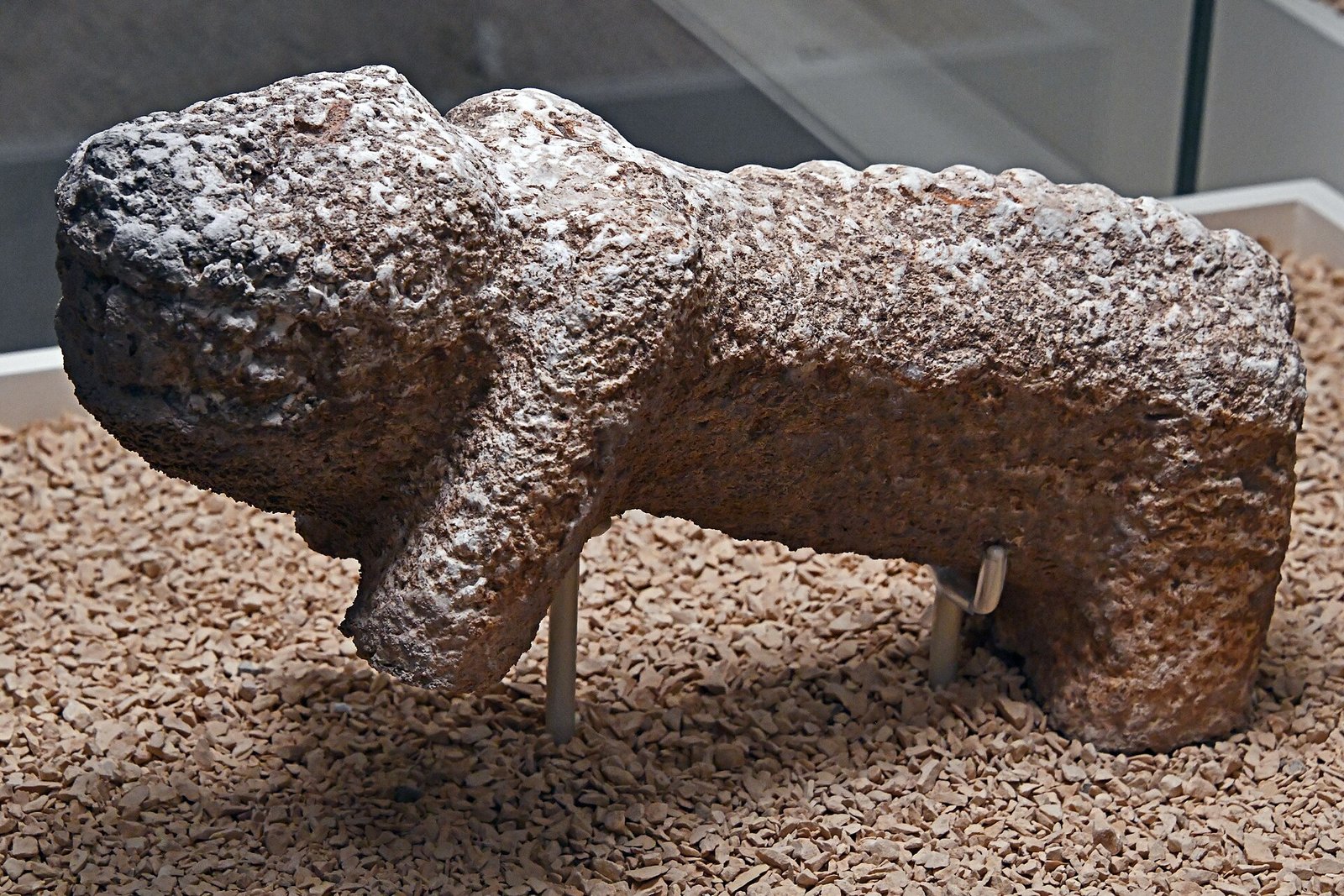
Why the leopard mattered so much is an open question, and one we treat carefully. Across the wider Taş Tepeler world the leopard recurs as a figure of danger and prestige — at neighbouring Sayburç, a famous relief shows a man flanked by two leopards, gripping his own body. The reading we find most compelling — and label plainly as interpretation — is that the leopard represented the danger of becoming prey, and the prestige of surviving contact with the thing that could destroy you. Read the full story of the leopard of Karahan Tepe →
The snake
The snake winds through Karahan Tepe's chambers. In the Pillar Room, a serpent flows in relief from the neck of the carved human head across the wall toward the standing pillars. In the neighbouring pit room, a snake is engraved along the bench. And running through the Pillar Room itself is a serpentine channel — a long, snake-like groove cut into the stone. Whatever the snake meant to these people, they returned to it again and again, in more than one medium.
The fox
In the pit room, beneath the stairs, a fox is carved into the rock. The fox is a recurring character across the wider Taş Tepeler world — it appears at Göbekli Tepe too — and it seems to have carried particular weight for these communities. At Karahan it sits in a quieter position than the snake, tucked into the architecture rather than dominating a wall.
The running wild donkey
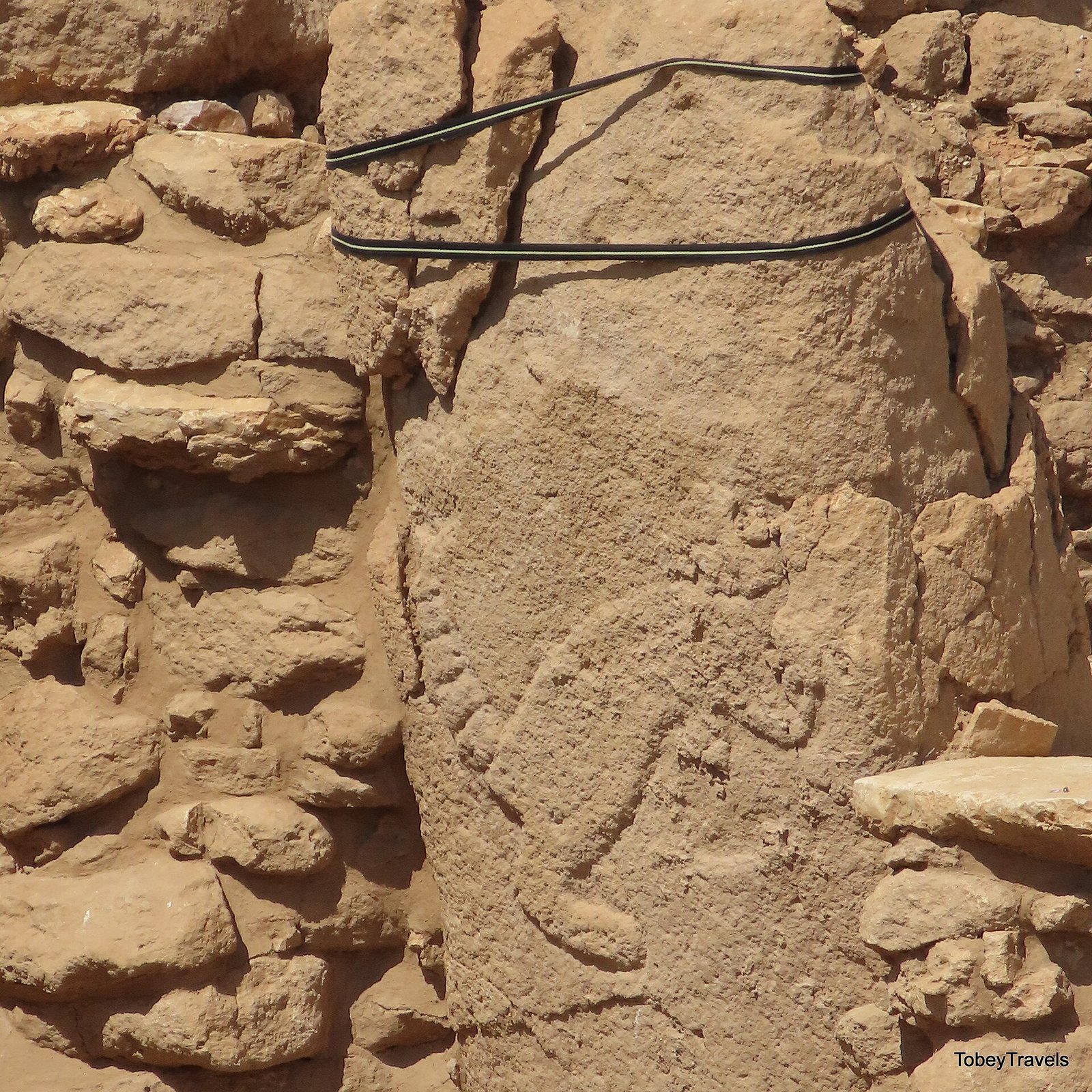
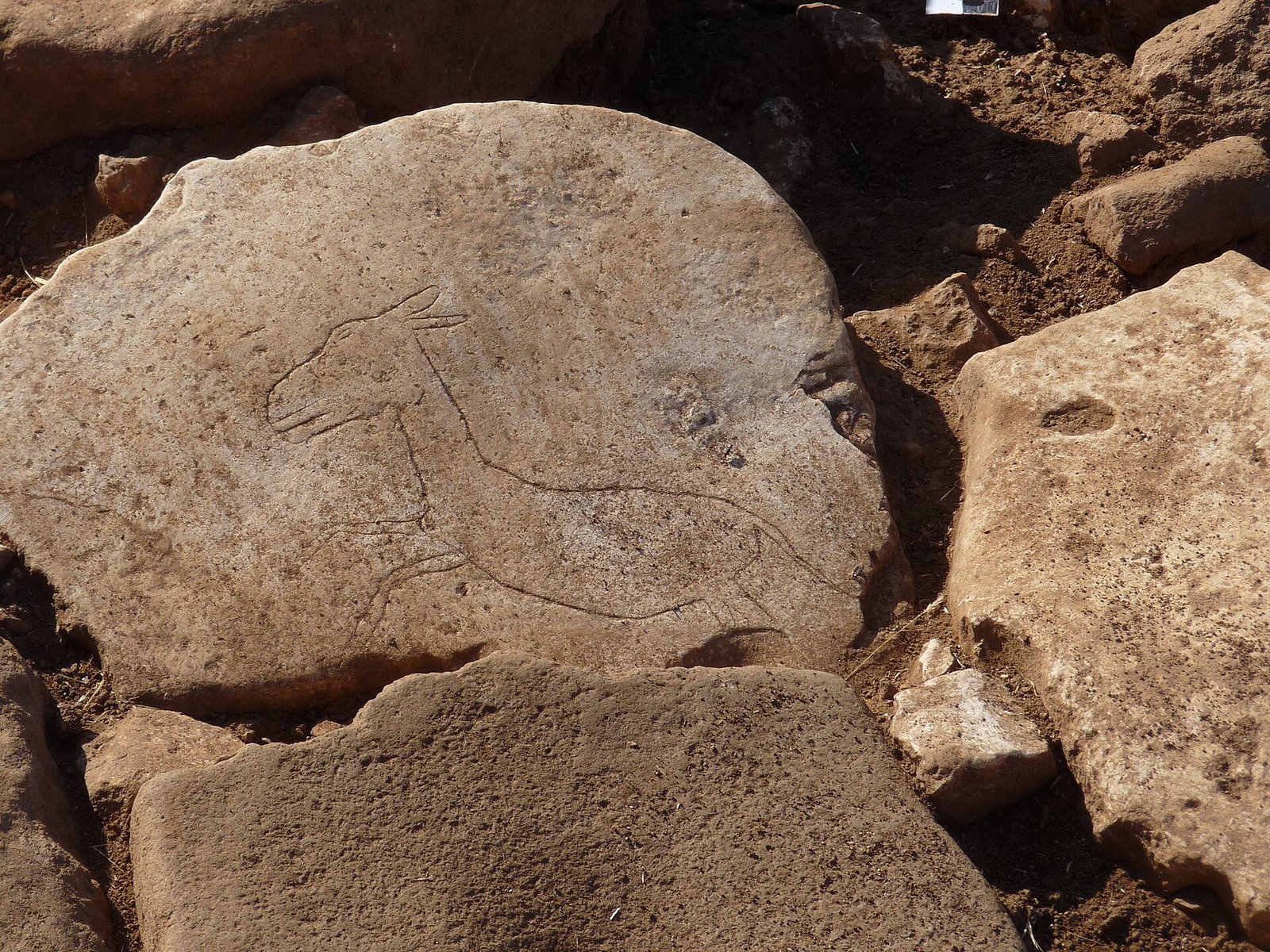
One of the most charming finds at the site is a small stone slab, only about twenty centimetres long, carved with a running wild donkey and set into a floor in a domestic part of the site. It's a reminder that not every image here is monumental or solemn — some are small, lively, and close to daily life.
The vulture
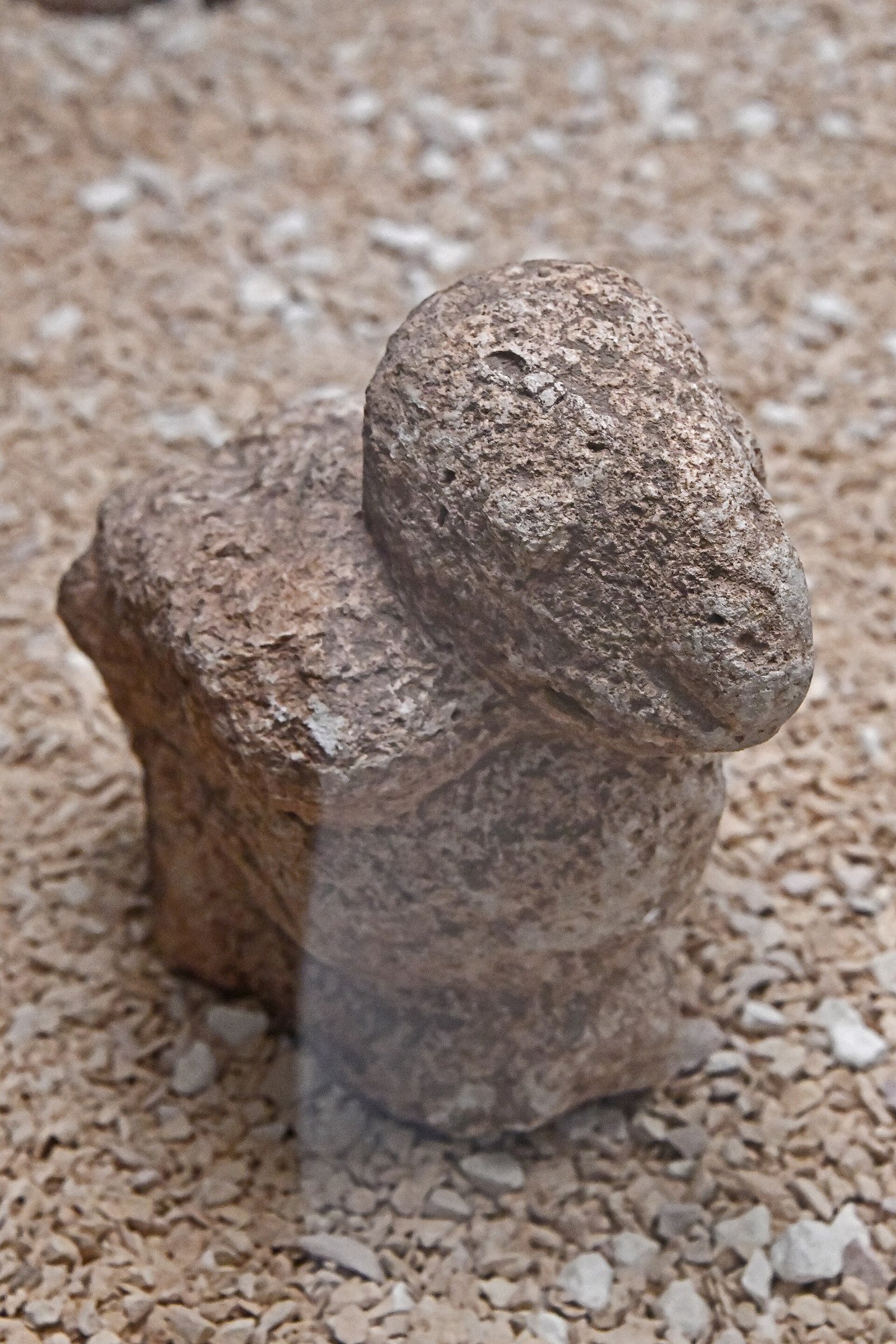
Karahan Tepe has also produced a vulture — a griffon-vulture sculpture associated with one of its Western Terrace buildings. Across this Neolithic world, vultures are strongly linked to death and the treatment of the dead; at Göbekli Tepe, the famous "Vulture Stone" is read by many as a scene about mortality. Karahan's vulture belongs to that same charged symbolic field.
And the human figure
The animals share the site with people. The carved human head, the human-faced pillar, and the seated statues mean that the bestiary is never purely animal — human and animal presences are placed together, watching the same rooms. That pairing is one of the most striking things about Karahan Tepe.
What did the animals mean?
Here we're careful. It is tempting to decode each creature — to say the snake "means" rebirth, the leopard "means" power, the vulture "means" death, the fox "means" cunning. The honest position is that we don't know, and that reading Neolithic animals as a fixed symbolic code usually says more about us than about them. What the evidence supports is subtler and more interesting: these animals were chosen deliberately, placed with intention, and clearly mattered. The leopard was singled out above all, in stone and in bone; the snake was returned to again and again through the chambers. We can describe the pattern with confidence. We just can't yet translate it, and we won't pretend to.
Frequently asked questions
What is the most important animal at Karahan Tepe?
The leopard. It is the apex predator — the one animal that could kill a person — and the only creature at Karahan rendered as freestanding sculpture (now in the Şanlıurfa museum) and also buried as selected bone among the site's curated deposits. No other animal was treated with the same care in both stone and bone. The snake is a recurring carved motif alongside it, but the leopard was singled out above all.
What animals are found at Karahan Tepe?
The leopard (as sculpture and curated bone), the snake (a recurring carved motif), a fox, a running wild donkey, and a vulture — alongside human heads and figures.
What does the snake mean at Karahan Tepe?
The snake recurs through the site as wall reliefs, a bench engraving, and a rock-cut channel. Its exact meaning is debated; across the region, serpents were clearly significant, but a single fixed interpretation isn't supported.
How is Karahan Tepe's animal art different from Göbekli Tepe's?
Göbekli Tepe features a wide menagerie — foxes, boars, snakes, scorpions, birds. Karahan Tepe narrows the focus to a few powerful figures, led by the leopard, with the snake and others recurring around it.
What does the vulture symbolise?
Across this Neolithic world, vultures are strongly associated with death and the treatment of the dead. Karahan's vulture belongs to that symbolic field, though its precise meaning at the site is not settled.
Karahan Tepe Research & Archive · Last updated July 2026.
Animal and symbol details (the snake reliefs, the pit-room fox, the running-donkey floor slab, and the griffon-vulture sculpture) draw on the Taş Tepeler project and Prof. Necmi Karul's reporting; some remain reporting-grade. We describe the imagery and avoid decoding it into fixed meanings. This is a living archive summary, not an official academic publication.
Explore further: The Enclosures · The Carved Heads · Human Figures