The Pillar Room — Key Facts
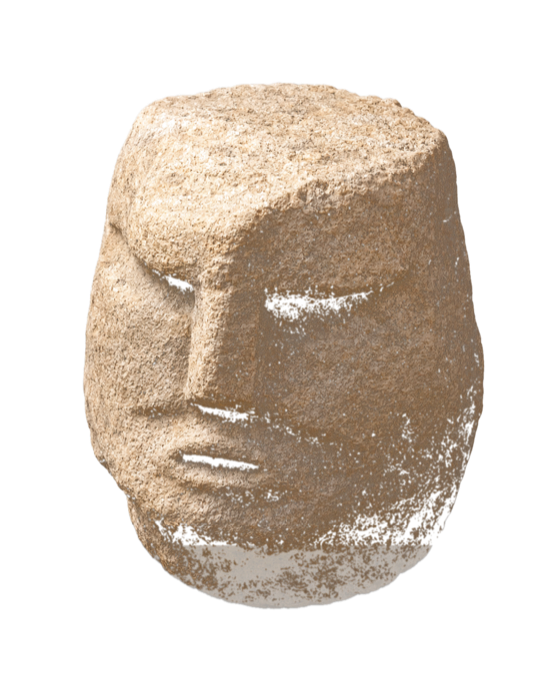
The Pillar Room — known to archaeologists as Structure AB — is a semi-subterranean chamber at Karahan Tepe, carved directly into the limestone bedrock. Inside stand eleven upright pillars — ten of them carved from the living bedrock in a stylised phallic form, plus a single inserted eleventh stone — while a life-size human head sculpted from the rock wall looks out over them, a snake in relief running from its neck across the wall. It is unlike any other structure known from the Neolithic world.
When it was fully uncovered in 2021, this single room turned Karahan Tepe from a promising survey site into international news — and it remains the clearest reason the site is spoken of alongside Göbekli Tepe.
What is the Pillar Room?
Rather than building walls up from the ground, the makers of Karahan Tepe carved the whole chamber down into the living rock, leaving the pillars standing where the stone was cut away around them. The result is an intimate, sunken room — about seven by six metres, and roughly three and a half metres deep — with a compressed, enclosing atmosphere completely different from the open circular enclosures of Göbekli Tepe. You entered it by descending: a small opening and a flight of steps on the south side led down into the space. It is one of three connected rock-cut rooms at the heart of the site, alongside the Central Building (Structure AD) and the shallower pit room (Structure AA).
The eleven pillars
The chamber's defining feature is a row of eleven pillars, each about two metres tall, rising directly from the bedrock floor. Several are carved in a stylised phallic form — a motif also known from other sites of the period. Standing together in the half-light of the sunken room, they read to many researchers as a gathering of figures — a deliberate assembly rendered in stone, rather than mere structural supports.
The head and the snake
Set into one wall, a human head emerges from the bedrock — apparently bearded — its neck extended so that it seems to lean out into the room. From it, a low relief of a snake runs sideways across the wall, parallel to the ground and toward the pillars. The snake is a recurring motif at Karahan Tepe, and here the head, the snake, and the ranked pillars combine into a single charged tableau. What it meant to the people who made it, we can't say with certainty — but its intent to impress and move the visitor is hard to miss.
How you moved through it — and how it ended
The Pillar Room did not stand alone. It sits with the site's largest chamber, the Central Building (Structure AD), and a shallower pit room (Structure AA) — three rock-cut rooms connected in what looks like a deliberate sequence. Inside AB itself, a serpentine channel — a long, snake-like groove — was cut into the chamber, echoing the snake beside the head. Next door in the Pit Room, a snake is engraved along a bench and a fox beneath the stairs.
And then, at the end of its life, the chamber was deliberately filled in and sealed — AB in careful, staged layers — as though the space were being closed rather than simply abandoned. The overall impression is of architecture built to be walked down into and moved through, and finally, purposefully, shut. We report these features as excavated; what the snake, the fox, and the closure meant remains open, and we don't pretend to have decoded them.
See also: what Karahan Tepe really looked like — the roof, and the missing heads.
What was the Pillar Room for?
Honestly, we don't know for certain — and any source that claims otherwise is guessing. What the evidence supports is that this was a ritual or ceremonial space, not an ordinary dwelling: the effort of carving it, the phallic pillars, the presiding head, the snake, and the adjacent water all point to symbolic rather than practical use. Interpretations range from fertility and regeneration to ancestor veneration and rites of passage. We present what the excavators have found and published, keep evidence separate from speculation, and note plainly where the questions are still open.
Frequently asked questions
What is Structure AB at Karahan Tepe?
Structure AB is the "Pillar Room" — a semi-subterranean chamber about 7 × 6 metres and roughly 3.5 m deep, entered by a stair on its south side, cut into the bedrock and containing eleven upright pillars, a carved human head, and a serpentine channel. It was fully revealed in 2021.
How many pillars are in the Pillar Room?
Eleven, each roughly two metres tall, rising directly from the rock floor. Several are carved in a stylised phallic form.
What is the carved head in the Pillar Room?
A life-size human head sculpted from the chamber wall, with a snake relief extending from it. It appears to preside over the pillars and is one of the most striking works of Neolithic art yet found.
Why is the Pillar Room important?
Because it shows hunter-gatherers, more than 11,000 years ago, carving a complex, symbolic ritual space out of solid rock — reshaping what we thought early humans were capable of before farming.
Karahan Tepe Research & Archive · Last updated July 2026.
Structure details (dimensions, the south descent, the serpentine channel, and the staged closure) draw on Prof. Necmi Karul's 2021 excavation report and the official Taş Tepeler project (tastepeler.org); further reading via the German Archaeological Institute's Tepe Telegrams and coverage in Smithsonian Magazine, Live Science, and Archaeology Magazine (2021–2025). This is a living archive summary, not an official academic publication; we update it as new findings are published.
Continue exploring: the interactive site overview · What is Karahan Tepe? · Karahan vs Göbekli Tepe