Karahan Tepe — Key Facts
Karahan Tepe is a monumental Neolithic complex in the hills east of Şanlıurfa, Turkey — the "sister site" of the more famous Göbekli Tepe. It is a place where people who had not yet invented pottery or agriculture nevertheless carved chambers, pillars, and human figures directly into the living rock, and gathered there for reasons we are only beginning to understand.
For most of the twentieth century, the story of civilization went like this: first humans learned to farm, then they settled into villages, and only much later — once there was surplus food and social hierarchy — did they build temples and monuments. Karahan Tepe and its neighbors turn that story upside down. The monuments came first.
A temple older than farming
Karahan Tepe dates to the Pre-Pottery Neolithic, broadly the same world as Göbekli Tepe — more than eleven thousand years ago. To put that in perspective, it is roughly six thousand years older than Stonehenge and more than seven thousand years older than the Great Pyramid of Giza. The people who built it were hunter-gatherers, without metal tools, writing, or domesticated crops.
That single fact is why the site matters so much. It suggests that the impulse to gather, to carve, and to build something monumental did not follow the rise of settled farming life — it may have helped drive it.
What you actually see there
The heart of the excavated site is a series of chambers cut into the bedrock. The most striking is a pillared hall containing rows of upright stone columns — several carved in a stylised phallic form — rising from the rock floor. Set into the wall of that chamber, a human head sculpted from the bedrock gazes out across the room, neck extended, as if emerging from the stone itself.
- The pillared chamber — a room of standing pillars carved from and rooted in the bedrock, unlike anything else known from this period.
- The rock-cut human head — a face emerging from the wall, one of the most evocative images in Neolithic art.
- T-shaped pillars — the same abstract, T-headed monoliths found at Göbekli Tepe, widely interpreted as stylized human or ancestral figures.
- Recent discoveries — in 2025, excavators uncovered a T-pillar carved with a human face, the first of its kind; later that year, an amphitheatre-like circular structure roughly seventeen metres across, with tiered stone benches cut into the limestone.
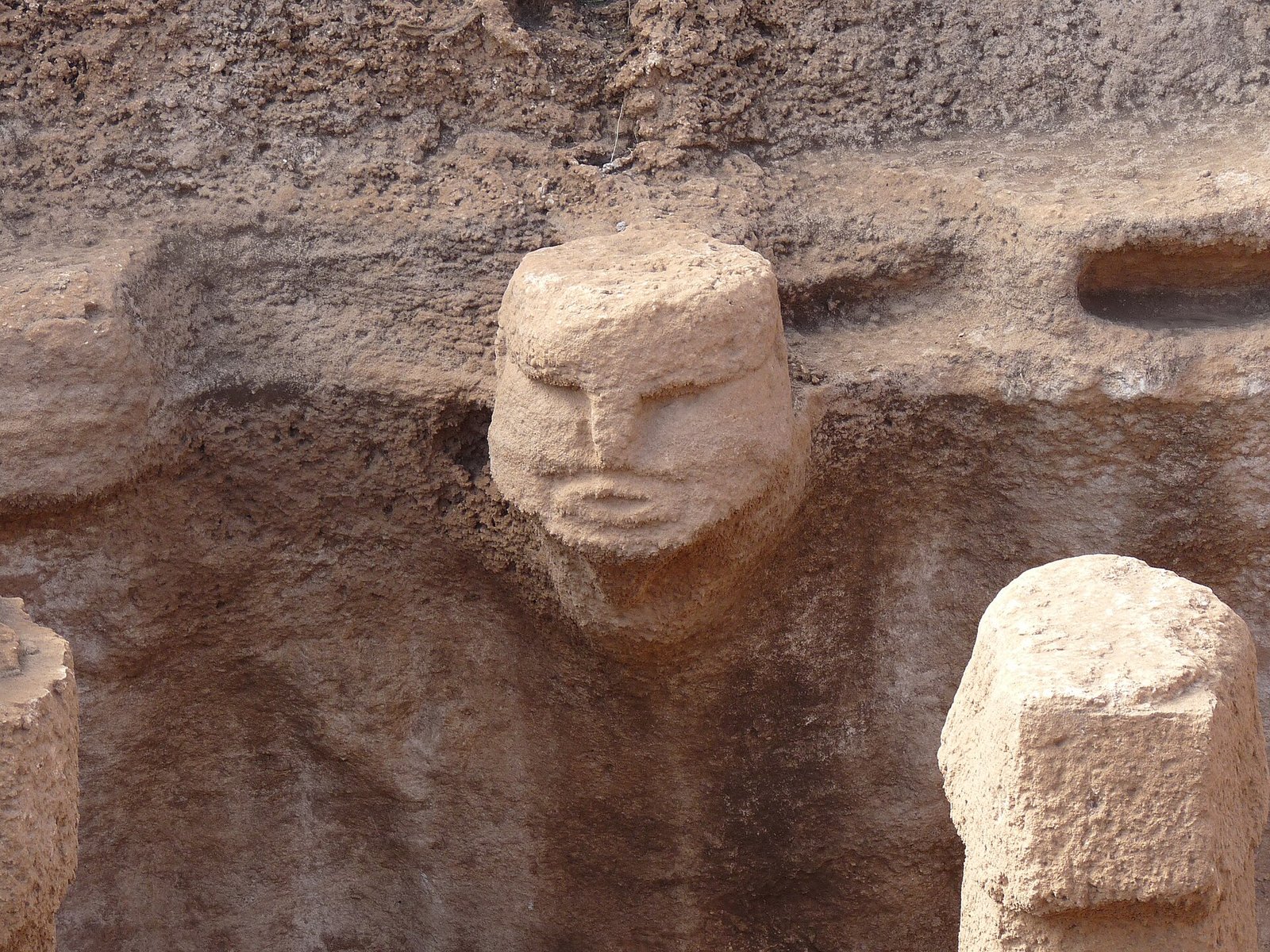
Inside the site: the pillars, the head, and the pool
The best-known structure at Karahan Tepe is a chamber archaeologists call Structure AB — often described as the "pillars room" or the pillared gallery. Cut into the bedrock and measuring roughly six by seven metres, it contains eleven upright pillars, each about two metres tall, standing together on the rock floor — several carved in a stylised phallic form. Watching over them, sculpted from the chamber wall, is a human head — apparently bearded — from which a low relief of a snake extends sideways, running parallel to the ground toward the pillars.
Structure AB did not stand alone. It was joined to several neighbouring structures in what looks like a deliberate sequence, so that a person might have entered at one end of the complex, passed the head and the standing figures, and exited at the other — a built, processional experience rather than a single room. Immediately adjacent is Structure AA, a rock-cut basin or "pool," a large cistern with channels running from it and the faint image of a snake carved along its rim. Water, the snake, the head, and the ranked pillars together suggest a charged, symbolic space — though what exactly happened there remains, honestly, unknown.
The "Ribbed Man": Karahan Tepe's haunting statue
In September 2023, excavators uncovered one of the most extraordinary objects in the entire Neolithic record: a 2.3-metre-tall statue of a man, set into a niche and fixed to the ground, carved around 9400 BCE. Nicknamed the "Ribbed Man," the figure is startlingly realistic — a defined face with eyes and nose, a bald head, and a torso whose ribs, spine, and chest are carefully incised, with the hands resting at the front of the body. The exposed ribs give the impression of a figure caught at the threshold of death or transformation.
Many researchers read him as a deceased ancestor associated with the building in which he was found — an individual, not a generic idol, carved with unmistakable identity and emotion. He is among the earliest fully realised, naturalistic depictions of a specific human being found anywhere on Earth.
How old is it — and how do we know?
Karahan Tepe belongs to the Pre-Pottery Neolithic. Stratigraphic and typological study place its earliest structures around 10,000–9,500 BCE, in the middle of the Pre-Pottery Neolithic A, with activity continuing until roughly 8000 BCE — on the order of fifteen centuries of use. Dating rests on the position of finds within the layers, the styles of the architecture and carvings, and radiocarbon work that continues to refine the picture as excavation proceeds. Because much of the site lay backfilled for millennia, its pillars, carvings, and statues survived in remarkable condition.
Who discovered it, and who is digging it
Karahan Tepe was first identified in 1997 by the archaeologist Bahattin Çelik, during a survey of the Şanlıurfa region, where he recognized T-shaped pillars protruding from the surface. For years it remained largely unexcavated. That changed in 2019, when systematic excavation began under Prof. Necmi Karul of Istanbul University, as part of the Turkish government's Taş Tepeler ("Stone Hills") project — a coordinated effort to explore a whole cluster of related Neolithic sites across the region. It is worth keeping in mind how early we still are: the site covers roughly ten hectares, and only a small fraction of it — on the order of a few percent — has so far been excavated. Almost all of Karahan Tepe is still underground.
Who built it — and why?
The honest answer is that we don't fully know, and any source that tells you otherwise is guessing. What the evidence supports is this: communities of hunter-gatherers, capable of impressive social coordination, invested enormous effort in carving and raising these structures. The recurring imagery — human figures, animals, and the T-pillars — points to a shared symbolic and probably ritual world across the region. Whether these were temples, gathering places, tombs, or something we have no word for is still debated by the archaeologists working there.
We take a simple approach on this site: we tell you what the excavators have actually found and published, we clearly separate evidence from interpretation, and where a question is genuinely open, we say so.
"Is it a lost civilization? Aliens?"
Because Karahan Tepe is so old and so sophisticated, it has become a magnet for dramatic theories — a lost advanced civilization, extraterrestrial builders, a vanished ice-age culture. These ideas are compelling, and it is worth understanding why they resonate. But there is no archaeological evidence for any of them. The far more remarkable truth, supported by the excavation, is that ordinary human beings — hunter-gatherers with stone tools — did this. That is the real story, and it is astonishing enough on its own. We weigh the lost-civilization, aliens, and Atlantis theories against the evidence here.
Karahan Tepe and the wider Taş Tepeler world
Karahan Tepe is not an isolated wonder. It belongs to a network of related Neolithic sites spread across the Şanlıurfa region — together called Taş Tepeler, meaning "stone hills." The best known is Göbekli Tepe, about an hour to the west, but the family also includes Sayburç (home to a carved narrative scene of a man facing leopards), Sefertepe, Çakmaktepe, Gürcütepe, Ayanlar Höyük and others. Read side by side, they reveal a whole culture that raised monuments, carved the human figure, and shared a symbolic language across the landscape — not a single miraculous site. We keep this archive focused on Karahan Tepe itself; for the whole family of sites, see our sister atlas, The First Temples.
If you're deciding where to start, our guide to Karahan Tepe vs Göbekli Tepe lays out how the two most famous sites compare, our interactive Explore page walks you through the structures and timeline, and our visitor guide covers how to see them for yourself.
Frequently asked questions
How old is Karahan Tepe?
More than 11,000 years old. Its earliest structures date to roughly 10,000–9,500 BCE, in the Pre-Pottery Neolithic, with the site used until around 8000 BCE — older than Stonehenge by about six thousand years and older than the Egyptian pyramids by more than seven thousand.
Who discovered Karahan Tepe, and who excavates it?
It was identified in 1997 by the archaeologist Bahattin Çelik. Systematic excavation began in 2019 under Prof. Necmi Karul of Istanbul University, as part of Türkiye's Taş Tepeler project.
Is Karahan Tepe older than Göbekli Tepe?
They are broadly contemporary — both Pre-Pottery Neolithic, more than 11,000 years old. Göbekli Tepe's most famous enclosures include some slightly earlier phases, but the two sites belong to the same world and were in use over overlapping periods.
What was Karahan Tepe used for?
Its exact purpose is debated. The rock-cut chambers, the ranked pillars, the carved head and the adjacent pool point to ritual or communal gathering rather than ordinary domestic life. Archaeologists are careful not to over-claim — but "a place people came together for something that mattered" is well supported.
What are the T-shaped pillars?
Upright stones with a distinctive T-top, found across the Taş Tepeler sites. Some carry carved arms, hands, and belts, which led researchers to read them as stylised human or ancestral figures — a ring of more-than-human presences rendered in stone.
Can you visit Karahan Tepe?
Yes. Karahan Tepe opened to visitors in 2025, with walkways and a protective shelter over the main structures. It's about an hour from Şanlıurfa; see our how-to-visit guide for the details.
What is the "Ribbed Man" statue?
A 2.3-metre stone statue of a man, carved around 9400 BCE and found in 2023, with realistic ribs, face, and hands. Many researchers interpret it as a depiction of a deceased ancestor — one of the earliest realistic portrayals of a specific human being ever found.
Sources & further reading: the official Taş Tepeler project (tastepeler.org), with descriptions by excavation director Prof. Necmi Karul; the German Archaeological Institute's Tepe Telegrams; and reporting from Smithsonian Magazine and the Şanlıurfa excavation announcements (2025). This page is a living archive summary, not an official academic publication; we update it as new findings are published.