 Karahan TepeResearch & Archive
Karahan TepeResearch & Archive
Karahan TepeResearch & Archive
Side by Side
They're often mentioned in the same breath — two 11,000-year-old temple sites, an hour apart in southeastern Turkey. So how do they actually differ, and which one should you visit? Here's the clear comparison.
Göbekli Tepe is world-famous — a UNESCO World Heritage Site and, for years, the poster child for "the world's first temple." Karahan Tepe is its younger-famous sister: discovered later, excavated more recently, and in some ways even more striking. Both belong to the same Neolithic culture, but they are not the same place.
Here is the short version, before we break it down: Göbekli Tepe is the icon — better known, more developed for visitors, and busier. Karahan Tepe is the frontier — quieter, newer to the public, and home to some of the most extraordinary carvings found anywhere from this age. If you can, see both. They're close enough to do in a single day.
| Karahan Tepe | Göbekli Tepe | |
|---|---|---|
| Age | More than 11,000 years old (Pre-Pottery Neolithic) | More than 11,000 years old — among the oldest, slightly earlier phases |
| Location | ~46 km east of Göbekli Tepe, near Şanlıurfa (about 1 hr by road) | ~12 km northeast of Şanlıurfa (about 20 min by road) |
| Discovered | 1997, by Bahattin Çelik | Recognized as significant in the mid-1990s by Klaus Schmidt |
| Excavation | Systematic dig from 2019, led by Prof. Necmi Karul | Excavated from 1995 onward; ongoing research today |
| Signature sight | A rock-cut pillared chamber, carved standing pillars, and a human head emerging from the wall | Great circular enclosures of T-pillars — including the carved "Vulture Stone" (Pillar 43) |
| Architecture | Chambers cut down into the bedrock, connected in a processional sequence | Rings of free-standing T-pillars built up on the ridge, backfilled over time |
| Star object | The "Ribbed Man" — a 2.3 m statue of a man (c. 9400 BCE), and the rock-cut head | The twin central T-pillars of Enclosure D — towering anthropomorphic figures with carved arms, hands, and belts |
| Heritage status | On Türkiye's UNESCO tentative list | UNESCO World Heritage Site (inscribed 2018) |
| Visitor setup | Open to visitors — an open-air, active dig (a protective roof is planned); fewer facilities than Göbekli | Well-developed: visitor center, walkways, protective canopy |
| Crowds | Quieter, fewer tour buses (for now) | The busier, more-visited of the two |
| Entrance | Currently free (confirm before travel) | Paid entry, ~€21 in 2026 (MüzeKart often accepted) |
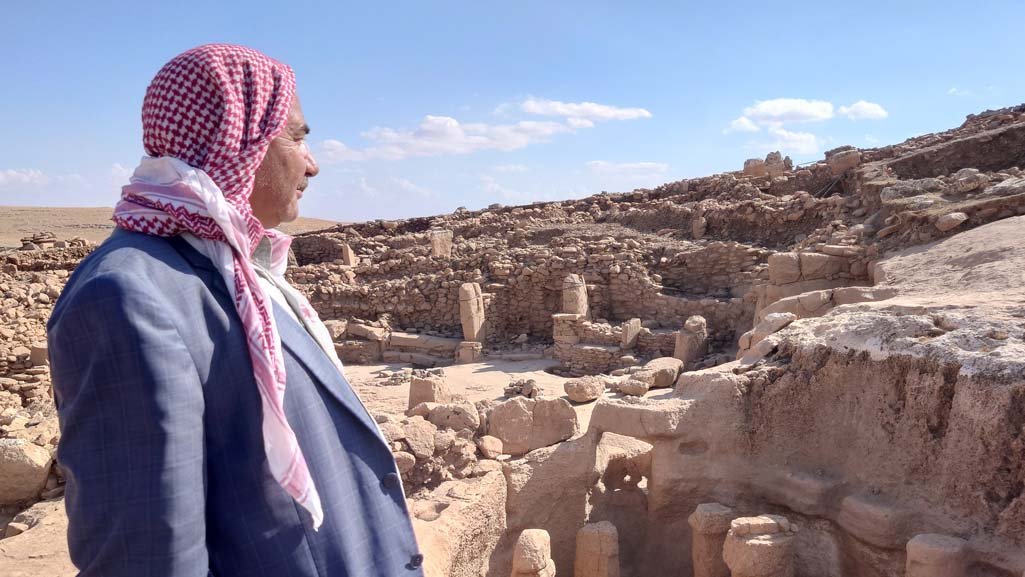
Göbekli Tepe is defined by its great circular enclosures — rings of massive T-shaped pillars, some over five metres tall, carved with foxes, boars, snakes, scorpions and birds. Its most famous stone, Pillar 43 (the "Vulture Stone"), has fueled decades of interpretation. It was Göbekli that first forced archaeologists to accept that monumental ritual architecture predated farming — the discovery that rewrote the textbooks. If you want to stand in the presence of the site that started it all, this is it.
Karahan Tepe is, in a sense, the more intimate and figurative site. Its showpiece is a chamber cut straight into the bedrock, filled with standing pillars — and a human face sculpted from the rock wall, watching over the room. Because it's being actively excavated, a visit today can feel like witnessing discovery in progress; the 2025 human-faced pillar and the amphitheatre-like structure found later that year are the kind of finds still emerging season by season.
They're roughly an hour apart by road, and with an early start you can comfortably see both in one day — ideally with the Şanlıurfa Archaeology Museum in between, where the famous "Urfa Man" and finds from both sites are displayed. Our how-to-visit guide lays out the timing, tickets, and the best way to combine them. And if you'd rather have an expert explain what you're looking at, our small-group tour does exactly that.
Beyond age and fame, the two sites represent two ways of building the same idea. Göbekli Tepe's builders raised monumental rings of free-standing pillars on top of a ridge, then covered them over time. Karahan Tepe's builders carved down into the bedrock itself, shaping chambers, pillars, a human head, and a basin out of the living rock. One is architecture added to the hill; the other is architecture subtracted from it. Together they show that the Neolithic communities of this region weren't following a single template — they were experimenting, in monumental stone, with how to gather and what to represent.
Both are more than 11,000 years old and broadly contemporary. Göbekli Tepe's most famous enclosures include some slightly earlier phases, but the two were in use over overlapping periods within the Pre-Pottery Neolithic. Göbekli Tepe is the site usually called the oldest temple in the world.
About 46 km apart, or roughly an hour by road. Göbekli is ~20 minutes from Şanlıurfa; Karahan is 50–70 minutes east of the city.
If you only have time for one, Göbekli Tepe is the closer, more developed, "must-see" icon. Karahan Tepe is quieter and more atmospheric, with active excavation. Ideally, visit both — they're easy to combine.
Yes — especially if you value seeing an actively excavated site with fewer crowds and some of the most striking Neolithic carvings found anywhere, including the rock-cut human head and the "Ribbed Man" statue.
Sources & further reading: the official Taş Tepeler project (tastepeler.org); the German Archaeological Institute's Tepe Telegrams; UNESCO World Heritage listings; and 2026 visitor information for the Şanlıurfa sites. Entrance fees and access arrangements change — confirm current details before you travel. This page is a living archive summary and is updated as information changes.
Peer-reviewed excavation detail follows Karul 2021. Finds reported in 2024–2025 seasons are cited to project announcements and reputable coverage and are flagged as reporting-grade pending formal publication. See Sources & Method and Open Questions.
See Both, With Experts
Our small-group expedition takes you through Karahan Tepe, Göbekli Tepe, and the wider Taş Tepeler region with expert guides who can tell you what you're actually looking at.
Visit with our expert team →Free E-Book
Join the archive and receive our free e-book — plus updates whenever new discoveries emerge from the Taş Tepeler region.
No spam. Unsubscribe anytime.