The Reconstruction — Key Points
Stand at Karahan Tepe today and you look down into open, roofless rooms, at pillars that rise bare from the rock. It is a powerful sight — but it is an unfinished one. Eleven thousand years ago these were not open-air ruins. They were, in all likelihood, covered rooms, entered from above or through narrow openings, lit by fire rather than sky. And the pillars that now stand blank were part of a world obsessed with the human head — a head that, in most cases, is no longer on the stone. To picture the real Karahan Tepe, you have to add back two things that time and excavation have taken away: the roof, and the heads.
It was sunken — and probably roofed
Karahan's core chambers were made by carving down into the bedrock, not building up from open ground. That already tells you something: a room dug into the earth wants a lid. The strongest structural clue is in the great central building, Structure AD, where a pair of enormous central pillars stands in the middle of the space. Free-standing central pillars, set where they carry no wall, are exactly what you would expect to find holding up a roof — and that is how many researchers, and the 3D reconstructions that have followed, read them. Some accounts also report possible traces of wooden elements, consistent with a timber-and-earth covering over a rock-cut room.
We label this honestly, because it is genuinely debated. No roof survives, and organic materials rarely do. Some scholars argue that if a covering existed it may have been partial — a shelter over part of the chamber — or seasonal, rather than a permanent enclosed roof. What is well founded is the reading of the central pillars as load-bearing supports; the full extent and permanence of any roof is an open question. (One thing to keep separate: a modern protective canopy is now being built over the site to shelter it from the weather — that is a 21st-century structure, not the ancient one.)
The pillars are bodies — and the heads are elsewhere
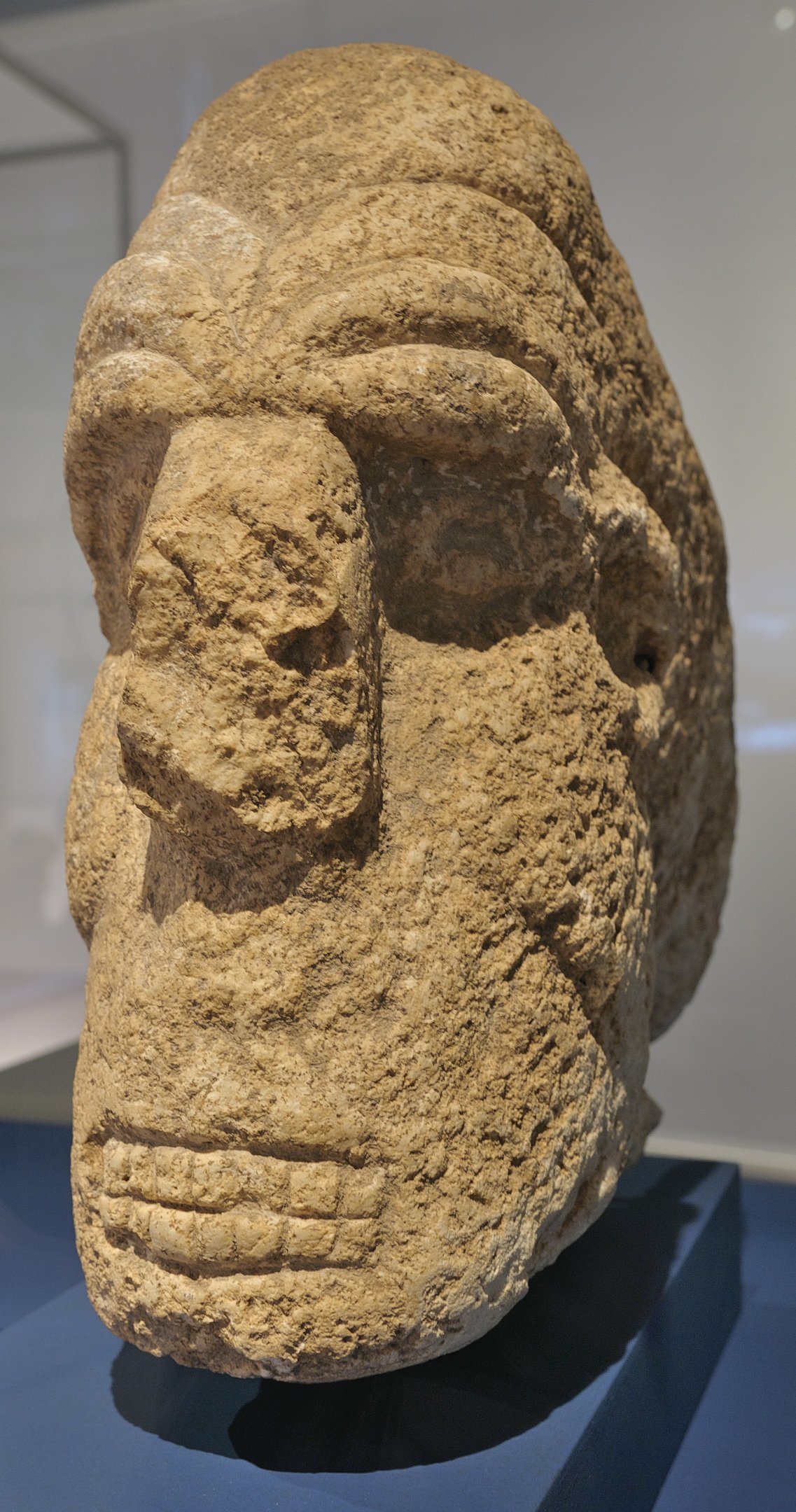
The second missing piece is stranger. Across Karahan Tepe and the wider Taş Tepeler world, the T-shaped pillars are read as stylised human figures — the wide top is a head-in-abstract, and some carry arms folded across the shaft, even belts. Karahan takes this "turning stone into body" further than anywhere else: it produced life-like carved human heads, a human-faced pillar, and full human statues — real faces, where the pillars give only the abstract idea of one.
And here is the honest version of a story you may have heard: many of Karahan Tepe's carved heads and human statues were lifted from the site and taken to the Şanlıurfa Archaeology Museum for protection — so the figures you'd expect to see in the rooms are, in fact, in glass cases in the city. That much is true and documented. What is not established is the stronger claim that every pillar once had a separate, removable head that was later taken away. That specific idea is not confirmed at Karahan. What we can say is that the head mattered enormously here, that separate carved heads and faces really did exist and were moved to the museum, and that at neighbouring Göbekli Tepe archaeologists have documented detachable stone heads that were removed and deliberately placed in the enclosures when the site was buried. Karahan belongs to that same head-focused world — but we mark the difference between "the heads are now in the museum" (true) and "every pillar had one removed" (not shown).
Putting the room back together
Add the two pieces back and the experience flips. You do not stand in an open ruin under the sun; you descend through a narrow opening into a closed, roofed room, lit by fire, sunk below the ground. Around you rise pillars understood as bodies, and — in stone set into the walls or standing among them — faces that watched you back. The blankness and the daylight are modern. The real Karahan Tepe was darker, tighter, roofed, and full of the human figure. That is the version worth carrying in your head as you look at the photographs.
What we claim, and what we don't
Frequently asked questions
Did Karahan Tepe have a roof?
Probably, at least in part. The great central pillars of Structure AD are widely read as roof supports, and some accounts report possible timber traces, so many researchers and reconstructions show the chambers roofed. But no roof survives, and some scholars argue any covering may have been partial or seasonal — so it remains an interpretation, not a proven fact. (A separate modern protective canopy is now being built over the site.)
Why do the Karahan Tepe pillars have no heads?
The T-shaped pillars were made as stylised human bodies, with the head rendered in abstract rather than as a realistic face. Separately, Karahan did produce life-like carved heads and statues — but many of those were removed to the Şanlıurfa museum, so the rooms today look emptier of faces than they once were.
Where are the carved heads and statues from Karahan Tepe now?
Many are held in the Şanlıurfa Archaeology Museum, which is the natural companion visit to the site. The Ribbed Man, the human-faced pillar, carved heads and other figures are displayed there.
Did every pillar at Karahan Tepe have a removable head?
That is not established. Detachable, deliberately placed stone heads are documented at neighbouring Göbekli Tepe, and Karahan clearly shared the same fascination with the head — but there is no confirmation that each Karahan pillar carried a separate head that was later removed. We keep that distinction clear.
Karahan Tepe Research & Archive · Last updated July 2026.
The reading of Structure AD's central pillars as roof supports, and the roofing question generally, draw on Taş Tepeler / Karul reporting and published reconstructions; the roof is inferred, not preserved, and its extent is debated. The relocation of carved heads and statues to the Şanlıurfa Archaeology Museum is documented; the "detachable heads" practice is established at Göbekli Tepe and is presented here as regional context, not as a proven Karahan fact. The modern protective roof over the site is a present-day conservation structure. This is a living archive summary, not an official academic publication.
Explore further: The Pillar Room (AB) · The Central Building (AD) · The Carved Heads · Human Figures