Structure BH — Key Facts
Structure BH is one of Karahan Tepe's best-preserved buildings — a rectilinear room beside Structure BD with walls standing up to three and a half metres high, two tiers of benches, broken T-pillars, and a large stone vessel set against the north wall with its own platform and channel.
A building for a liquid
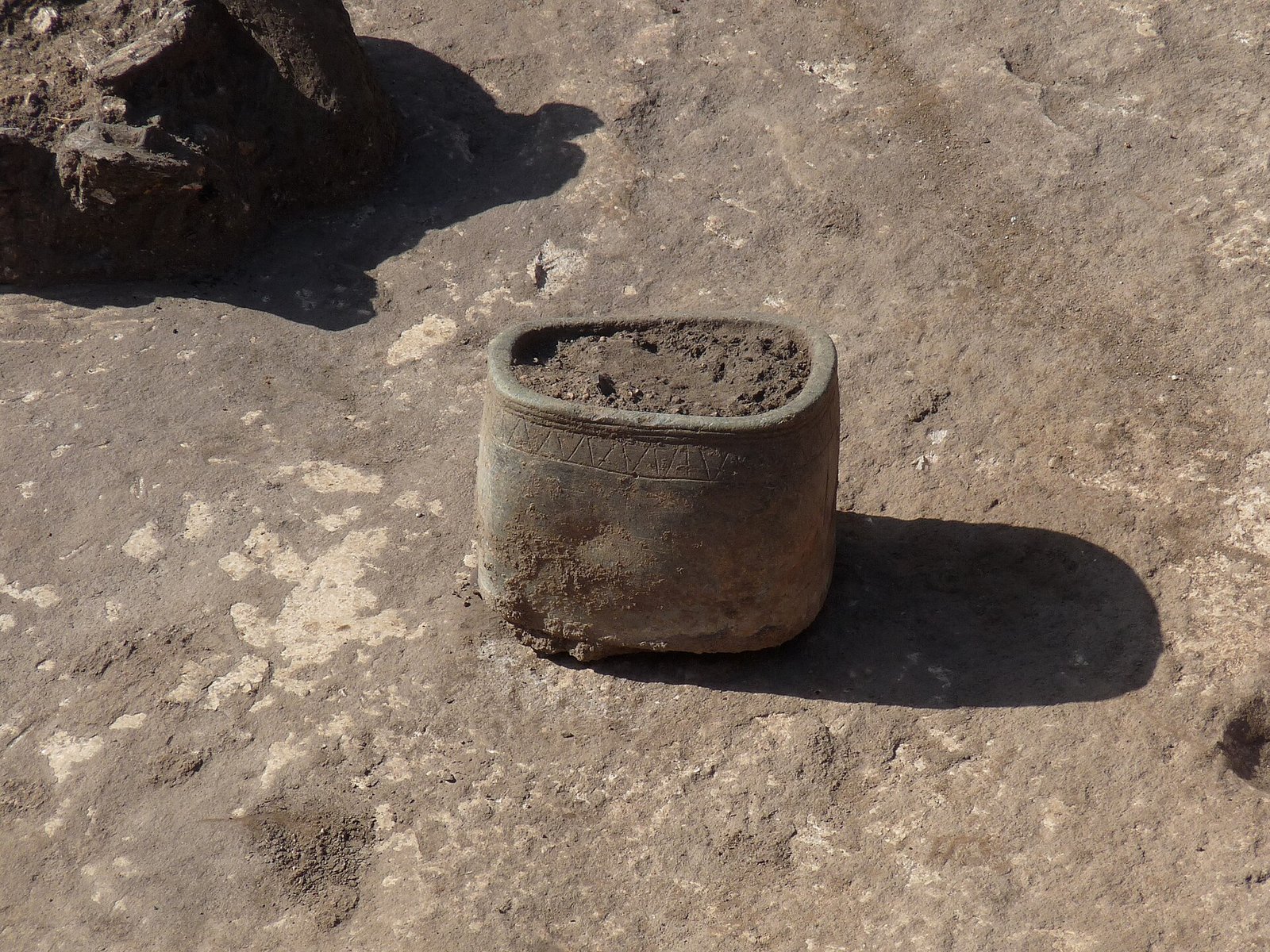
In November 2025, this building was shown to the public for the first time, and it is one of the most complete rooms yet uncovered at Karahan Tepe. It is rectilinear, about 9 × 7 metres, with plastered walls surviving up to roughly 3.5 metres high — remarkable preservation for an 11,000-year-old structure. Inside are two stepped, rock-cut benches and four symmetrically placed pillars (found broken). But the feature that makes BH extraordinary sits against the north wall: a large stone bowl set into the wall, with a channel cut in front of it to carry liquid away.
What moved through the channel?
A bowl fixed into a wall, with a channel leading away from it, is built to move something — and the natural reading is a liquid. Excavation director Prof. Necmi Karul has said the building "was used for some ritual reason, and this liquid was a part of this ritual." We report that as his interpretation. What the liquid was — water, blood, a brewed drink, something else — is not known, and we do not guess. The channel joins a wider pattern at Karahan of liquid deliberately moved through architecture, echoed by the rock-cut serpentine channel in the Pillar Room. Alongside the bowl, the room also carries strong floor burning and heat-damaged benches — fire and liquid, in the same space.
Beside the seated figure
BH does not stand alone. It sits directly beside Structure BD, the earlier building that produced a seated human sculpture set on a bench. Two neighbouring rooms — one holding a seated figure, the other a liquid installation — give this corner of Karahan Tepe the feel of a linked ritual complex, though exactly how the buildings related is still being worked out.
What we claim, and what we don't
Frequently asked questions
What is Structure BH at Karahan Tepe?
A well-preserved rectilinear building, about 9 × 7 m with plastered walls up to ~3.5 m high, containing two stepped benches, four pillars, and a north-wall stone bowl with a channel that carried liquid away. It was shown publicly in November 2025.
What was the stone bowl and channel used for?
The excavators read the bowl-and-channel installation as ritual, with a liquid playing a central role — the words are Prof. Necmi Karul's. What the liquid was, and the precise ceremony, remain unknown.
Why is Structure BH important?
Its preservation is exceptional, and its bowl-and-channel points to liquid being moved deliberately through architecture — part of a wider Karahan pattern that also includes the Pillar Room's serpentine channel.
Karahan Tepe Research & Archive · Last updated July 2026.
Draws on the building's public presentation in November 2025 (reported by Türkiye Today and others, with commentary from Dr. Lee Clare of the German Archaeological Institute) and earlier Stone Mounds / Taş Tepeler material. Dimensions, benches, pillars, the north-wall bowl and channel, and the burning are reported; the "ritual liquid" reading is attributed to Prof. Necmi Karul. We use the excavator's designation and avoid assigning a single settled function. This is a living archive summary, not an official academic publication.
Browse all enclosures on the Enclosures index, or see them in context on the interactive overview.