 Karahan TepeResearch & Archive
Karahan TepeResearch & Archive
Karahan TepeResearch & Archive
Deep Dive · Symbols & Animals
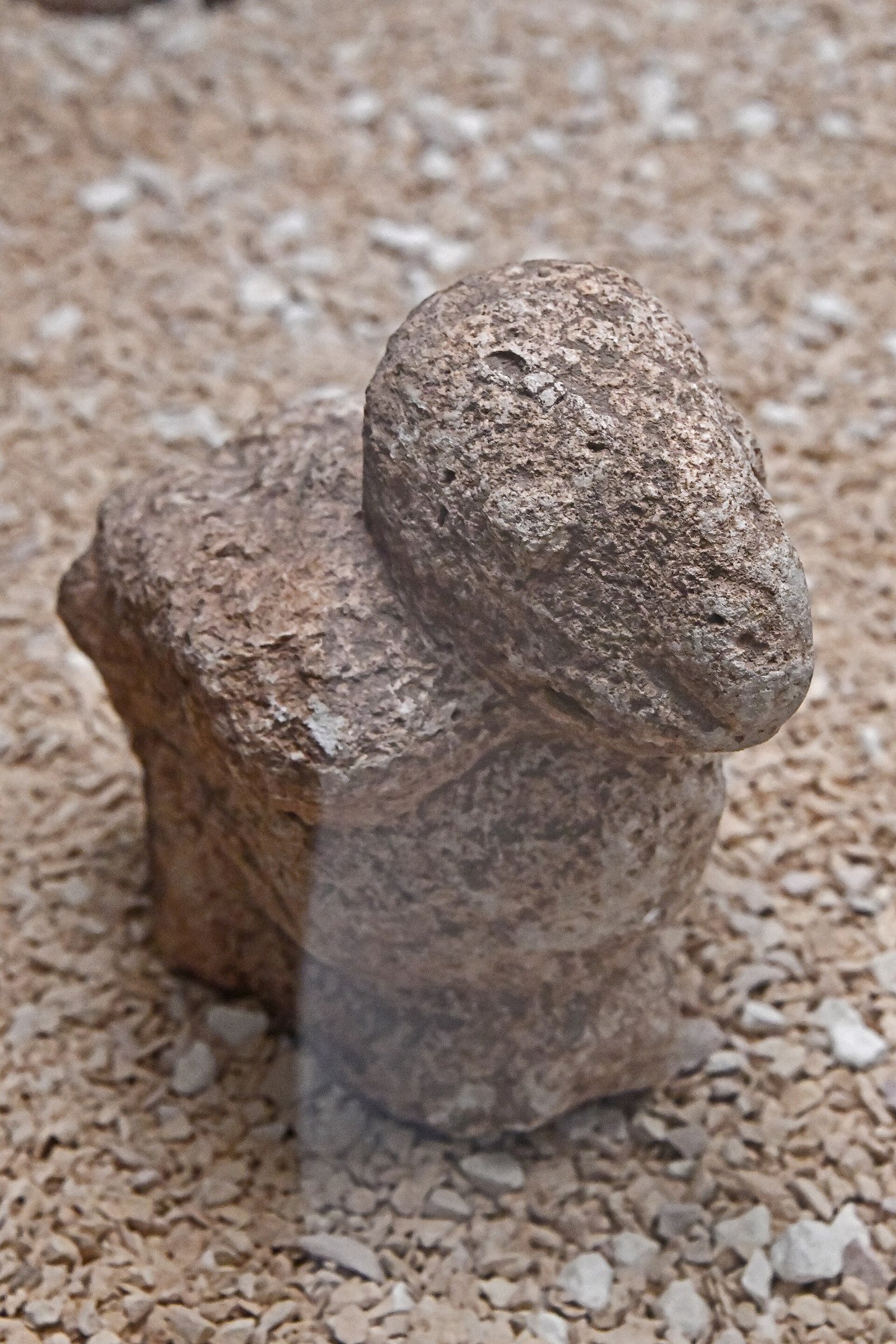
A carved vulture, found in 2023 standing beside the 2.3-metre "Ribbed Man" beneath a porthole in the wall. Across the Taş Tepeler, this bird belongs to death — and here it keeps watch over a corpse.
When excavators opened a new building at the top of Karahan Tepe in September 2023, they found more than the famous Ribbed Man. Standing near him, carved in stone, was a vulture — prominent beak, wings wrapped around its front, worked with real skill. Set on the north wall below a porthole, with the corpse-like statue beside it and human bone in the room, the bird reads as no accident.[1]
The vulture belongs to the same charged assembly as the Ribbed Man: on the northern wall, beneath a large circular porthole stone set between two T-pillars, the bird was placed, while immediately to the right the 2.3-metre human statue stood on a stone bench, and a carved stone plate lay on the floor before them.[1] This is the enclosure of the Western Terrace (Structure BD) — the single richest findspot at Karahan Tepe. The vulture was not decoration scattered on a wall; it was part of a deliberately staged space.
Across the Pre-Pottery Neolithic of this region, the vulture is one of the most loaded of all animals — bound up with death and the handling of the dead. The most famous example is Göbekli Tepe's “Vulture Stone” (Pillar 43), where vultures appear with a headless human figure. Many researchers connect these images to excarnation: the practice of exposing the dead so that scavenging birds strip the body, before the bones (especially the skull) are curated. At Karahan, the vulture stands beside a statue read as a corpse, with real human bone nearby — a tableau of death rendered in stone and, it seems, enacted in fact.[2]
The vulture joins Karahan's other great predator, the leopard, in a bestiary that is anything but gentle — snakes, foxes, a wild boar, and now a scavenging bird (see Symbols & Animals). But where the leopard speaks of danger and power, the vulture speaks of endings. It connects directly to Karahan's concern with the dead: the curated skulls and human remains, the corpse statue, the deliberate sealing of chambers. The bird is the hinge between the living who gathered here and the dead they carried with them.
The vulture sculpture is a confirmed find; its findspot beside the Ribbed Man is reported by the excavation. The meaning — death, excarnation, rebirth — is a well-supported interpretation grounded in the regional pattern, but it is interpretation, not a decoded message. We present it as such, and we steer clear of the fringe astronomical readings that have attached themselves to this particular find.
Was the vulture a specific mythic figure, or a general emblem of death? Did the porthole, the plate, the bird and the corpse statue form a single scene with a fixed meaning, or accumulate over time? And how does Karahan's vulture relate to Göbekli's — shared belief, or local variation on a regional theme? These are open. What's certain is that at Karahan Tepe, as at its neighbours, the vulture was chosen, carved, and placed with care — a bird the living clearly needed close to their dead.
A carved stone vulture found in 2023 in the Western Terrace enclosure, standing beside the 2.3 m "Ribbed Man" statue below a porthole in the wall, with a carved stone plate and human bone in the same room.
Across the region, vultures are associated with death and the treatment of the dead — often linked to excarnation (exposing bodies to scavenging birds). The Karahan vulture, beside a corpse statue and human bone, fits that pattern, though the specific meaning is interpretive.
They share the vulture-and-death theme. Göbekli's Pillar 43 shows vultures with a headless human figure; Karahan's is a free-standing sculpture in a death-charged enclosure.
Karahan Tepe Research & Archive · Last updated September 2026.
The Karahan Tepe vulture sculpture (found September 2023 in the Western Terrace enclosure, beside the 2.3 m human statue, below a porthole, with a carved stone plate and human bone nearby) is reported from Türkiye's Ministry of Culture and Tourism announcement and reputable coverage; exact findspot, phase and object metadata await formal publication and are flagged reporting-grade. The death / excarnation symbolism is a well-supported interpretation grounded in the regional record, offered as interpretation. We do not endorse the astronomical (Cygnus) readings attached to this find. Image: the vulture sculpture, Şanlıurfa Archaeology Museum. This is a living archive summary, not an official academic publication.
The find is cited to the 2023 announcement and reputable coverage; the death symbolism is interpretation. See Sources & Method and Open Questions.
Explore further: The Leopard · The Ribbed Man · Who Built It & the Dead · Symbols & Animals
Free E-Book
Join the archive and receive our free e-book — plus updates whenever new discoveries emerge from the site.
No spam. Unsubscribe anytime.