 Karahan TepeResearch & Archive
Karahan TepeResearch & Archive
Karahan TepeResearch & Archive
A Window Between Rooms
Between the sunken Pillar Room and the great Central Building, the builders left a small, deliberate opening — a "porthole" in the stone. A tiny window, and one of the site's quiet mysteries.
Two of Karahan Tepe's most important rooms are not simply neighbours — they are connected. Between the sunken Pillar Room (Structure AB) and the great Central Building (Structure AD), the builders cut a small, deliberate opening: a porthole. It is easy to walk past in a photograph, but it is one of the most telling details on the site — because it means these chambers were designed to relate to one another, kept in contact even once you were sealed inside.
A "porthole stone" is a slab or wall pierced by a neat, often circular opening — a window or a low passage cut through solid stone. They are a recurring feature of the Neolithic Near East, and they turn up across the Taş Tepeler world, including at Göbekli Tepe, where porthole slabs are among the site's known architectural elements. Some were large enough to crawl through; others were small, more like windows or apertures than doorways. Their very deliberateness — a carefully worked hole in a wall that took real effort to make — tells you they mattered.
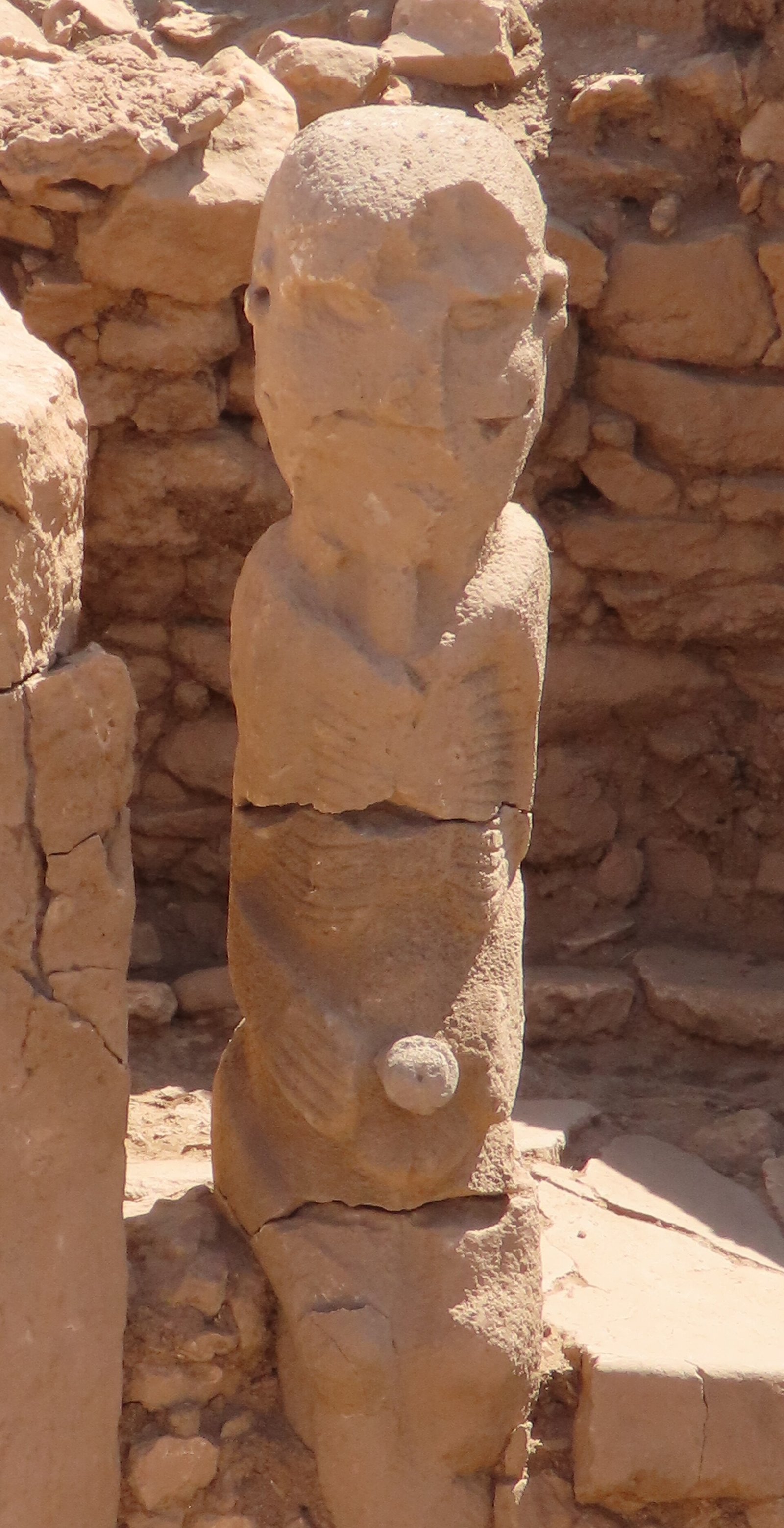
At Karahan Tepe the porthole does something specific: it joins the Pillar Room to the Central Building. The excavation records a small opening connecting Structure AB — the intimate, phallus-filled chamber with its watching head — to the wide communal hall of Structure AD. And the connection runs deeper than a single hole: the Pillar Room appears to have been reached by passing through the Central Building in the first place. The two rooms were bound together, one large and open, one small and hidden, with the porthole as a literal point of contact between them.
Here we open the interpretive door and mark it as such. A small window between a public hall and a hidden chamber invites obvious readings: a sightline, letting people in the large room see (or be seen from) the sunken one; a passage for objects, offerings, or a chosen person; or a symbolic threshold — a controlled point of contact between an open, communal space and a charged, concealed one. Across the Neolithic, porthole stones have been read as boundaries between worlds — between inside and outside, the living and the dead, the seen and the hidden. Any of these could fit Karahan's porthole. None is proven. What the stone itself tells us is narrower and still remarkable: the builders wanted these two rooms connected, and they worked the rock to make it so.
A small, deliberately carved opening in the stone that connects the Pillar Room (Structure AB) to the Central Building (Structure AD). It is a documented physical link between the two chambers.
A slab or wall pierced by a worked opening — a window or low passage cut through solid stone. Porthole stones are a recurring Neolithic feature and appear across the Taş Tepeler region, including at Göbekli Tepe.
Its purpose isn't settled. Reasonable readings include a sightline between the two rooms, a passage for objects or people, or a symbolic threshold between a public and a hidden space. We present these as interpretations, not fact — what's documented is that it connected the chambers.
A popular claim: that this porthole channels the winter-solstice sunrise onto the carved head. We lay it out honestly — and explain why the excavators don’t accept it — in Is Karahan Tepe Aligned to the Winter Solstice?
Karahan Tepe Research & Archive · Last updated July 2026.
The opening connecting Structure AB and Structure AD, and the route through AD, follow Karul (2021) and Taş Tepeler reporting; porthole stones are a documented regional feature (including at Göbekli Tepe). Readings of the porthole's function — sightline, passage or symbolic threshold — are interpretation and are labelled as such. This is a living archive summary, not an official academic publication.
Peer-reviewed excavation detail follows Karul 2021. Finds reported in 2024–2025 seasons are cited to project announcements and reputable coverage and are flagged as reporting-grade pending formal publication. See Sources & Method and Open Questions.
Explore further: The Pillar Room (AB) · The Central Building (AD) · The One-Way Path · What It Looked Like
Free E-Book
Join the archive and receive our free e-book — plus updates whenever new discoveries emerge from the site.
No spam. Unsubscribe anytime.