 Karahan TepeResearch & Archive
Karahan TepeResearch & Archive
Karahan TepeResearch & Archive
Structure AB · Fertility
Ten pillars raised from the living bedrock — described by the excavator as phallus-shaped — and an eleventh stone carried in and placed among them. To descend into this room was to stand inside a field of generative stone.
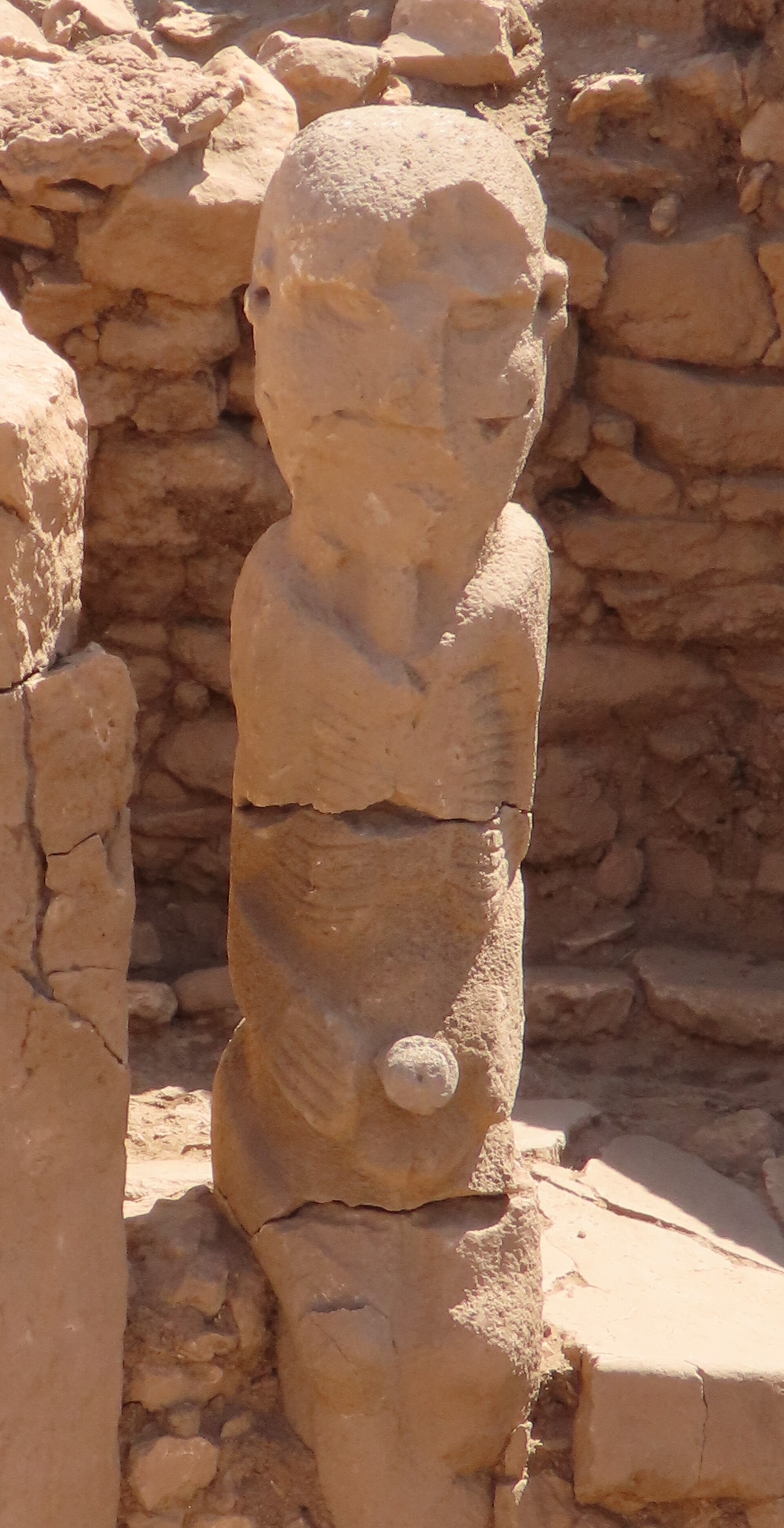
The room that made Karahan Tepe world news is, at heart, a room full of phalluses. Inside Structure AB, ten upright pillars were shaped directly from the living bedrock — carved where the rock was cut away around them, not set in like posts — and the excavator, Prof. Necmi Karul, describes them as phallus-shaped. An eleventh, different from the rest, was carried in and placed among them. To descend the stairs into this sunken chamber was to lower yourself into a standing field of generative stone, under the gaze of a carved human head.
The arrangement is precise. Four taller pillars, roughly 1.6 to 1.7 metres high, stand in the front, facing the chamber's carved human head. Behind them stand six shorter pillars, about 1 to 1.4 metres. All ten were cut from the bedrock floor itself — which is what makes them feel less like installed architecture and more, as one reading puts it, like organs of the hill. The count rises to eleven because of one more element: a separate shaped flat plate, set into a shallow bed. It is not one of the fixed bedrock phalluses. It was brought in.
Here we separate the excavator's description from anyone's interpretation. That the pillars are phallus-shaped is Karul's reported reading of their form. What that meant is not settled — and we won't pretend it is. The interpretation we find most compelling, and label plainly as ours, runs like this: to enter Structure AB was to stand inside a field of male generative force. And fertility here should not be softened into a gentle symbol of abundance. In a world of injury, infant mortality, hunting danger, hunger, and fragile group survival, fertility was survival pressure — the continuation of the group itself. A room built to surround the body with generative stone is, on this reading, a room about the most urgent thing there was.
The placed plate is the hinge of the room, and the most openly interpretive part of this page. Because it is not one of the fixed bedrock phalluses — because it was shaped elsewhere and set among them — we read it as an arrival inside the room: a brought-in form entering a field of generative stone. In our wider synthesis it may echo Karahan's theme of predator power — a person bearing or becoming entangled with a leopard — carrying that charge into the chamber. This is a hypothesis, held open on purpose, and kept clearly separate from the plain inventory: ten belong to the room's own carved body; one was brought in.
The phalluses did not stand exposed forever. At the end of the room's life, Structure AB was deliberately filled: stones were packed among the pillars, flat slabs laid over their tops, and the south stair blocked. The generative field was, in the end, sealed shut — one more act in Karahan Tepe's long habit of closing what it had built.
Ten pillars carved from the bedrock of Structure AB, described by the excavator as phallus-shaped, plus a separate eleventh stone placed among them — eleven upright elements in total.
The four taller front pillars stand about 1.6–1.7 m; the six shorter rear pillars about 1–1.4 m. All ten were carved directly from the bedrock floor.
Their phallic form is the excavator's description; the meaning is interpretive. A widely discussed reading is fertility or male generative force — understood not as gentle abundance but as the pressure of group survival. We present that as interpretation, not settled fact.
A separate shaped plate placed among the ten bedrock pillars. Because it was brought in rather than carved from the floor, some readings treat it as a deliberately "arrived" element — a hypothesis we keep open and separate from the plain inventory.
Karahan Tepe Research & Archive · Last updated July 2026.
The pillar count, heights, arrangement and the "phallus-shaped" description follow Karul (2021) and the Structure AB inventory; the later filling is documented. The fertility and "eleventh stone" readings are our interpretation, offered as open hypotheses and kept separate from the described finds. This is a living archive summary, not an official academic publication.
Peer-reviewed excavation detail follows Karul 2021. Finds reported in 2024–2025 seasons are cited to project announcements and reputable coverage and are flagged as reporting-grade pending formal publication. See Sources & Method and Open Questions.
Explore further: The Pillar Room (AB) · The One-Way Path · An Initiation Site? · Human Figures
Free E-Book
Join the archive and receive our free e-book — plus updates whenever new discoveries emerge from the site.
No spam. Unsubscribe anytime.