 Karahan TepeResearch & Archive
Karahan TepeResearch & Archive
Karahan TepeResearch & Archive
Structure AD · The Structures
Known to the excavators as Structure AD, this is the largest building yet uncovered at Karahan Tepe — a great hall about 28 metres across (its interior later rebuilt down to ~18), ringed with two-step benches and standing pillars. It looks like the communal heart of the whole site.
Structure AD is the largest building yet found at Karahan Tepe — a great hall that originally measured about 28 metres across and was rebuilt three times — its interior finally reduced to roughly 18 metres — partly cut into the living bedrock and ringed with two-step stone benches and upright pillars. If the Pillar Room next door is the site's most mysterious space, Structure AD is its communal heart: a hall built to bring a large group of people together.
It is also one of the largest structures known from the entire Pre-Pottery Neolithic — which is remarkable for a community that had not yet taken up farming.
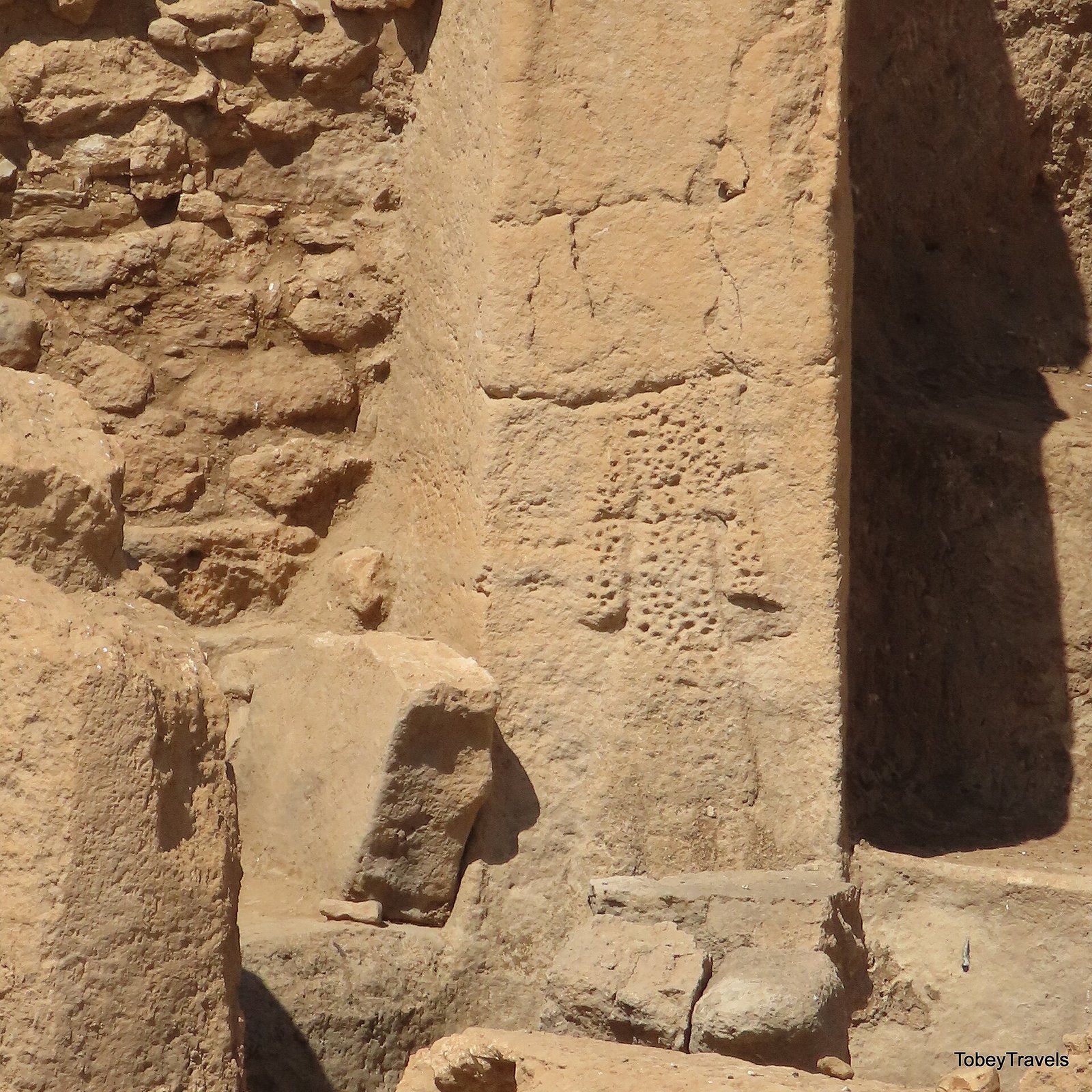
Like the rest of Karahan Tepe's core, Structure AD was made by carving down into the bedrock rather than building up from the ground. The result is a wide, partly sunken hall. Running around its interior are two-step (tiered) benches — low stone seats cut in two levels — while pillars stand against the walls and a pair of larger central pillars anchor the middle of the space. In the floor are deep pits, and excavators have found broken objects deliberately placed within the building.
In its final form the hall held about 17 pillars set at intervals around the wall — roughly twenty in all across its history — with two tall central pillars, about 5.5 m high, standing face to face in the middle, their tops worked into blunt, head-like projections. The two-step benches were divided by uprights into about fifteen niche-like bays — a tiered, inward-facing seating plan of the same kind reported in 2025 as the site’s “amphitheatre” (the two may well be one and the same). In scale and plan it closely parallels Structure D at Göbekli Tepe.[3]
The tiered benches are the telling detail. Seats arranged around a central focus are, almost by definition, architecture for assembly — for a group to sit together and attend to something happening in the middle, where the paired central pillars stand. Some reporting suggests the benches could seat on the order of a couple of hundred people. We'd put it carefully: Structure AD was clearly built to hold a substantial community at once. Exactly what they gathered for — ceremony, feasting, decision-making, or all of these — is not something the evidence yet settles, and we won't pretend it does.
The interior was not bare. In a niche in the southern part of the hall sat a carved human head — with two paws gripping it from above, showing it had been broken from a larger human-and-leopard composite sculpture. A low podium was built up, its bottom step a pillar laid on its side and carved with an animal head and a leopard-skin pattern. Nearby, fixed to a bench, stood a statue of a person with an animal on their back, set among stone vessels. When the building was closed, many of these sculptures were deliberately broken and buried inside it.[3]
Structure AD does not stand alone. It is joined to the neighbouring Pillar Room (Structure AB) — the sunken chamber of eleven pillars and the carved head — as part of a single connected core. Reading the two together, you get a sense of a designed complex: a large communal hall beside a smaller, more intense, more hidden chamber. Movement between the two seems to have mattered.
Like other buildings at Karahan Tepe, Structure AD was not simply abandoned. At the end of its life it was deliberately filled in and closed, with broken objects placed inside as part of the process. Whether we read that as a respectful "retirement" of the building or as something more ritually charged, the intent is clear: the hall was purposefully brought to an end, not left to decay.
The floor itself was cut into the bedrock across a natural fault line, which the builders repaired and paved over. Set into it are pits — one about 2 m wide and 1.9 m deep — that physically link Structure AD to the Pillar Room (AB) and to the neighbouring Structure BF; a few human bones found in one of them suggest they also served for burial.[3]
We follow the evidence and the excavators here, and we're careful with the label. Structure AD is best described as a large central communal building — the site's principal gathering space. It is tempting to call it a "theater," a "temple," or a "council house," but those words import functions we can't yet demonstrate. What we can say is well supported: it was big, it was built for people to come together, its pillars gave the space a charged focal point, and it was ceremonially closed. The rest is still being excavated.
It is the largest building yet found at the site — a central communal hall that originally spanned about 28 metres (its interior later reduced to roughly 18), partly cut into the bedrock, with two-step benches, wall and central pillars, and floor pits. It was deliberately filled in at the end of its use.
Originally about 28 metres across, rebuilt three times with its interior finally reduced to roughly 18 metres — still one of the largest known Pre-Pottery Neolithic buildings.
Its tiered benches point to communal gathering — a place for many people to come together. The precise purpose (ceremony, feasting, assembly) is still debated, and we avoid over-claiming a single function.
It was deliberately closed at the end of its life, with broken objects placed inside — a purposeful "closing" of the building rather than simple abandonment. The exact meaning is still discussed.
Karahan Tepe Research & Archive · Last updated October 2026.
Structure details (dimensions, the three rebuildings, two-step benches, central pillars, interior sculptures, floor pits and the closing fill) follow Prof. Necmi Karul's excavation reporting — the 2021 paper and the fuller 2025 account in The Neolithic in Türkiye, Vol. 7 — together with official Taş Tepeler project material; capacity figures reported in secondary coverage are noted as such. We use the excavator's designation "Structure AD" as the canonical name and avoid assigning a single settled function. This is a living archive summary, not an official academic publication.
Peer-reviewed excavation detail follows Karul 2021. Finds reported in 2024–2025 seasons are cited to project announcements and reputable coverage and are flagged as reporting-grade pending formal publication. See Sources & Method and Open Questions.
Nearby structures: The Pillar Room (AB) · The Carved Heads · Human Figures. Or return to the interactive overview.
See It For Yourself
Our small-group expedition takes you into Karahan Tepe's chambers with expert guides who explain what the benches, pillars, and pits actually tell us.
Visit with our expert team →Free E-Book
Join the archive and receive our free e-book — plus updates whenever new discoveries emerge from the site.
No spam. Unsubscribe anytime.