 Karahan TepeResearch & Archive
Karahan TepeResearch & Archive
Karahan TepeResearch & Archive
Discoveries · 2023 Season
A 2.3-metre human statue from around 9400 BCE — ribs, a V-collar, hands at the groin, and traces of paint — found on a bench beside a vulture. One of the oldest realistic human sculptures on Earth.
It is the statue that made the world look twice at Karahan Tepe. In September 2023, excavators opening a new building at the top of the hill uncovered a 2.3-metre human figure — taller than any person — its ribs and spine cut deep into the stone, a V-shaped collar at its neck, and its hands brought to the groin. Carved around 9400 BCE, it is one of the oldest realistic human sculptures ever found. Researchers took to calling it the “Ribbed Man,” or the “Corpse Statue.”[1]
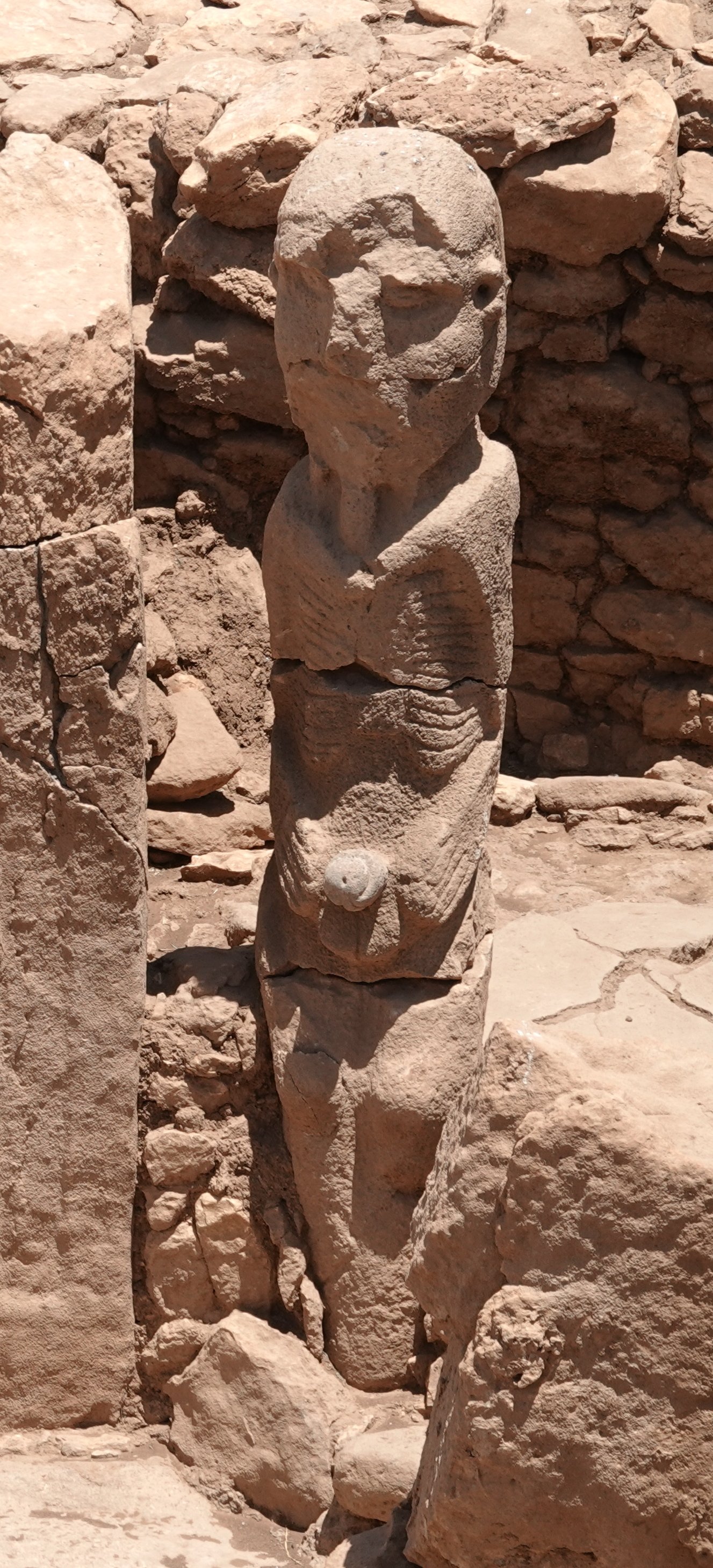
The figure was discovered broken in two: the upper body had fallen and lay on the floor, while the legs were found in situ, still set upright on a stone bench, fixed into the building.[1] Its face is unusually legible for something so old — defined eyes and nose, a beard, and a distinctive hairstyle. Most strikingly, its surface still carries traces of red, white and black pigment, making it one of the earliest painted human sculptures known: these figures were not bare grey stone but coloured, vivid presences.[1]
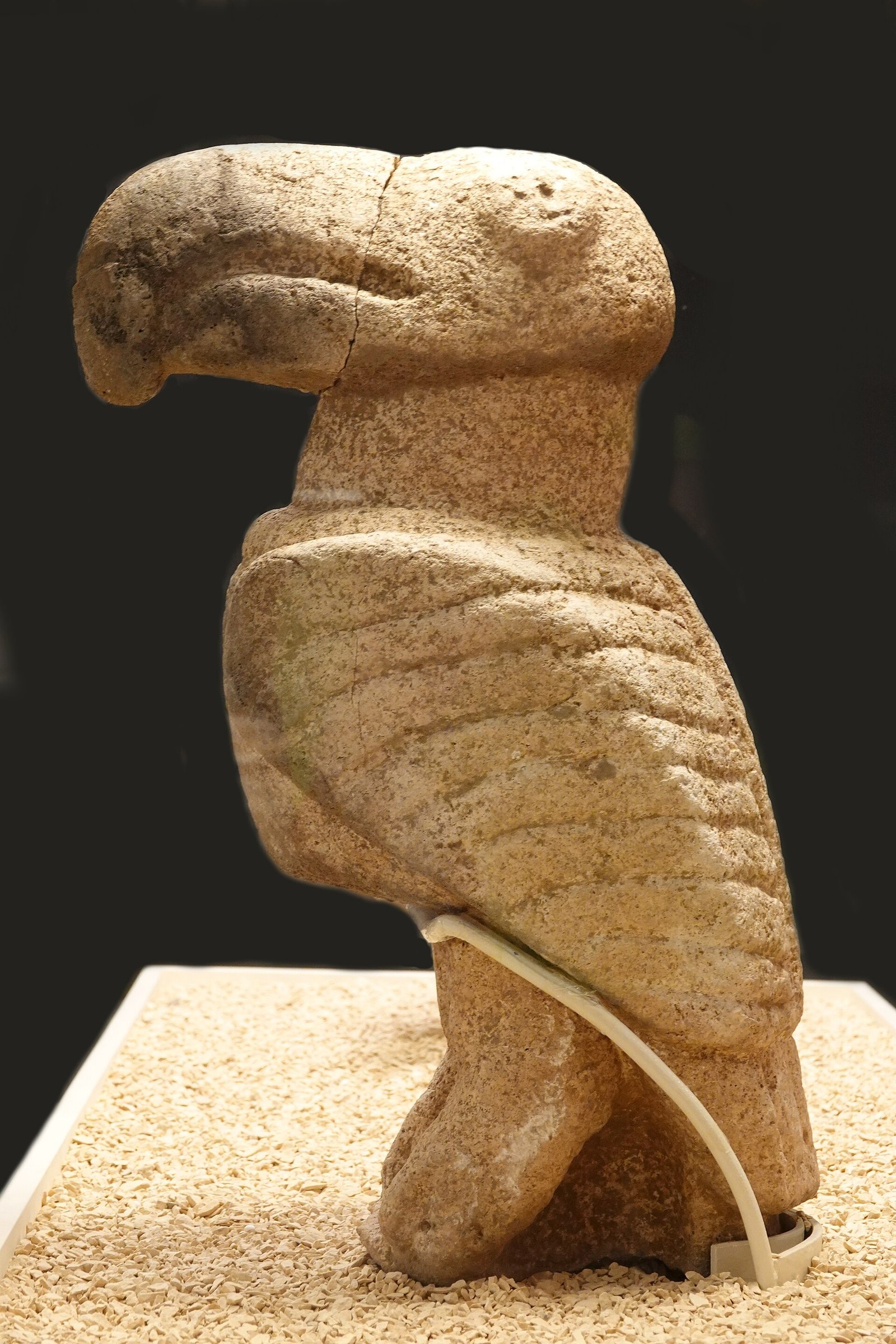
The Ribbed Man did not stand alone. In the same enclosure, excavators found a carved vulture sculpture placed nearby, a carved stone plate set on the floor in front of the figures, a large porthole stone in the wall between two big T-pillars, and human bone.[1] That assembly — a larger-than-life human, a scavenging bird associated across the region with death, a vessel, and actual human remains — reads as a deliberately composed, charged space. We report the objects as found; the ceremonial reading is a strong interpretation, and we hold it as one.
Two readings sit side by side, and both come from the carving itself. The bared ribs and gaunt frame point to death — this may be a depiction of a dead person, an ancestor, or a body prepared for burial, a reading reinforced by the vulture and the human bone. At the same time, the figure's hands at the groin and emphasised anatomy echo a wider Taş Tepeler theme of male fertility, seen also in the phallic pillars of the Pillar Room and in the “Urfa Man” statue.[1] Death and fertility together — ending and renewal — may not be a contradiction but the point. We present both as interpretations, not decoded fact.
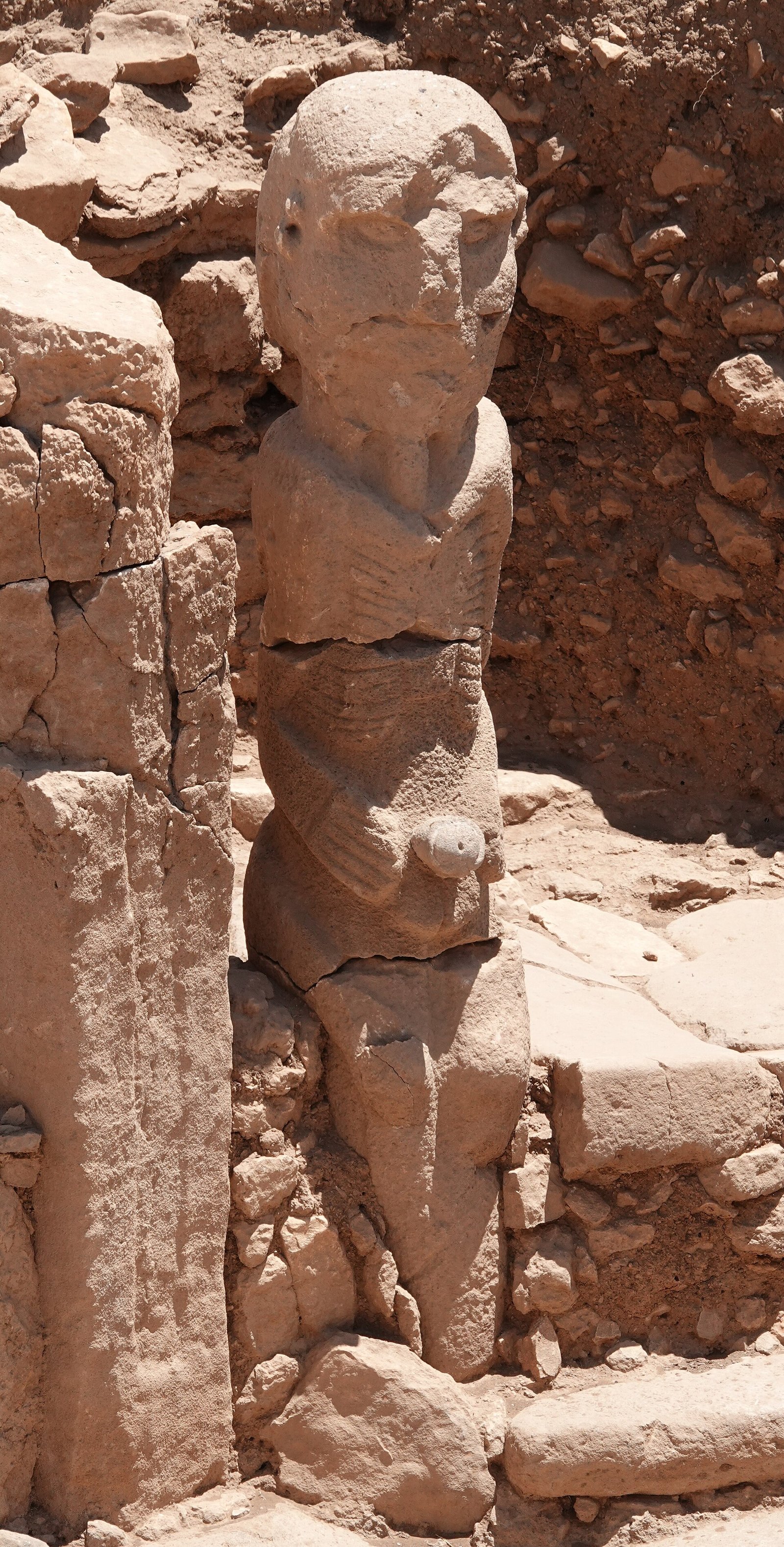
The Ribbed Man is the anchor of Karahan's defining theme: the human form. Before Göbekli Tepe yielded comparable figures, Karahan had already produced this — the world's earliest known realistic human statue, in a chamber built around it. It sets the stage for everything that followed: the carved heads, the 2025 human-faced pillar, the amphitheatre of seated statues, and the 2026 human-on-leopard statue. At Karahan, people put themselves at the centre of the world they built.
Who is he? A specific ancestor, a mythic figure, a generic image of the dead? Why larger than life — status, or simply to be seen from the benches around him? How do the death and fertility readings fit together, and what happened in the chamber with the vulture, the plate and the bone? The formal excavation report will refine the context; until then we keep these open, and we steer clear of the fringe theories this statue tends to attract. What's certain is extraordinary enough: 11,400 years ago, someone carved a painted, life-sized human being — and it still holds our gaze.
A 2.3 m human statue from Karahan Tepe, carved around 9400 BCE, found in 2023 on a bench beside a vulture sculpture. It has deeply carved ribs, a V-collar and hands at the groin, and traces of red, white and black paint — one of the oldest realistic human sculptures known.
Because its bared ribs and gaunt frame suggest a depiction of the dead — a reading reinforced by the vulture and human bone found in the same chamber. It is an interpretation, not a settled fact.
Yes — it preserves traces of red, white and black pigment, making it one of the earliest known painted human sculptures.
Karahan Tepe Research & Archive · Published September 2026.
The Ribbed Man (2.3 m, c. 9400 BCE, ribs / V-collar / hands at the groin, pigment traces, found on a bench with a vulture sculpture, a stone plate, a porthole stone and human bone) was announced in September 2023 by Türkiye's Ministry of Culture and Tourism and is reported here from that announcement and reputable coverage; full stratigraphic context awaits formal publication and is flagged reporting-grade. The death and male-fertility readings are interpretations, offered as such. We deliberately exclude the pseudo-archaeological claims (giants, "ancient astronauts," speculative star alignments) that circulate around this find. Photographs shown are of the statue and the vulture sculpture (Şanlıurfa Archaeology Museum / on site). This is a living archive summary, not an official academic publication.
Finds reported in the 2023–2026 seasons are cited to project announcements and reputable coverage and are flagged as reporting-grade pending formal publication. See Sources & Method and Open Questions.
Explore further: Human Figures at Karahan · Who Built It & the Dead · The Carved Heads · More discoveries
Free E-Book
Join the archive and receive our free e-book — plus an update whenever a new find emerges from Karahan Tepe.
No spam. Unsubscribe anytime.