 Karahan TepeResearch & Archive
Karahan TepeResearch & Archive
Karahan TepeResearch & Archive
Structure AZ · The Structures
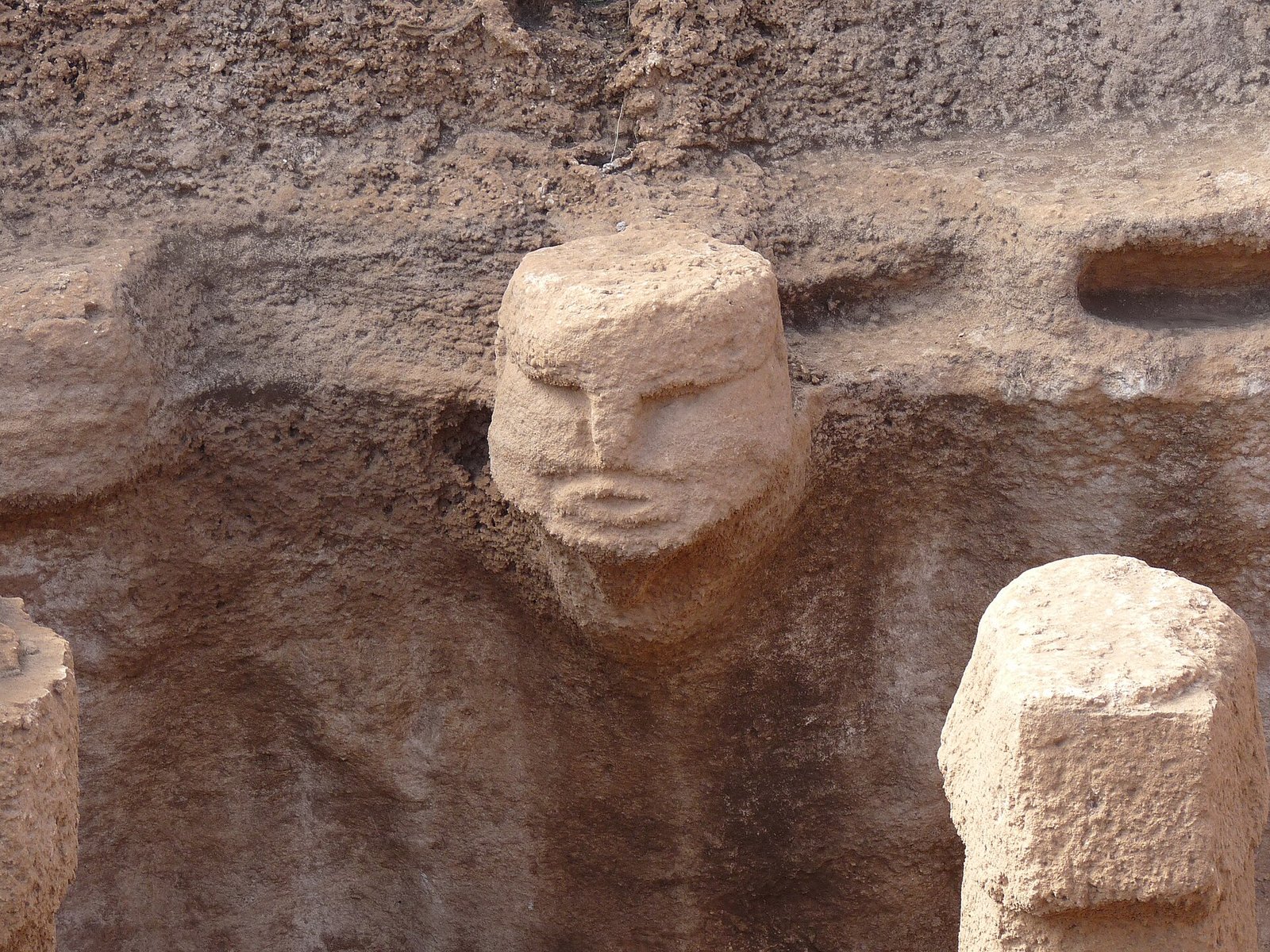
A plaster-floored house on the Western Terrace — and the findspot of the first T-shaped pillar ever carved with a human face, announced to the world in October 2025.
Structure AZ is where Karahan Tepe made world headlines again in October 2025 — the domestic building on the Western Terrace that produced the first T-shaped pillar ever found carved with a human face. It also quietly rewrites a lazy assumption: that Karahan’s wonders live only in its grand sunken chambers. This one came out of a house.
Project reporting describes AZ as a domestic building on the Western Terrace — a sunken, clay-plastered room built into the bedrock, with a stone-paved floor, plastered benches, grinding stones, and a small group of T-shaped pillars that likely served as both roof supports and symbols.[1][2] In October 2025 the Turkish Ministry of Culture and Tourism announced that one of these pillars carried a human face — deep-set eyes, a broad flat nose, a sharply chiselled jaw — on a standing stone about 135 cm tall.[3][4] The minister framed it as the first example of a Neolithic person carving themselves into a T-shaped pillar.
For years, archaeologists have argued that the T-pillars of Göbekli and Karahan are not just posts but stylised bodies — abstract human figures, sometimes with arms, hands and belts. AZ’s face is the strongest single piece of evidence yet that the builders themselves thought this way, turning an interpretation into something much closer to demonstrated intent.[3][5] That it appeared in a domestic structure, not a monumental enclosure, also blurs the neat line between “sacred” and “everyday” that early accounts of the site leaned on.
AZ belongs to the newer Western Terrace buildings excavated alongside BD and BH, and it connects directly to the site’s wider obsession with the human head — the carved head of the Pillar Room, the statues in the human-figure series, and the theme explored in The Carved Heads.
The face is real and dated to roughly the start of the ninth millennium BCE.[3] What it meant — a specific ancestor, a deity, a generic “person” — is not established, and we don’t claim that every T-pillar is therefore a portrait. The formal plan, locus, and object catalogue for AZ still await publication; until then we treat its finer details as reporting-grade.
A domestic Western-Terrace building containing grinding stones, plastered benches and small T-pillars — one of which, about 135 cm tall, was carved with a human face and announced in October 2025.
It is the first T-shaped pillar known to carry a human face, strong evidence that the builders understood these pillars as human figures.
Karahan Tepe Research & Archive · Last updated July 2026.
Peer-reviewed detail follows Prof. Necmi Karul’s 2021 excavation report; 2024–2025 finds are cited to project announcements and reputable coverage and flagged as reporting-grade pending formal publication. We use the excavator’s structure designation as the canonical name and do not collapse the evidence into a single settled function. This is a living archive summary, not an official academic publication.
Peer-reviewed excavation detail follows Karul 2021. Finds reported in 2024–2025 seasons are cited to project announcements and reputable coverage and are flagged as reporting-grade pending formal publication. See Sources & Method and Open Questions.
Browse every excavated structure in The Atlas, or see them in context on the interactive overview.
See It For Yourself
Our small-group expedition takes you into Karahan Tepe's chambers with expert guides who explain what each one actually tells us.
Visit with our expert team →Free E-Book
Join the archive and receive our free e-book — plus updates whenever new discoveries emerge from the site.
No spam. Unsubscribe anytime.