 Karahan TepeResearch & Archive
Karahan TepeResearch & Archive
Karahan TepeResearch & Archive
Deep Dive · Daily Life
Arrowheads, sickle blades and scrapers — and obsidian carried from hundreds of kilometres away. Karahan Tepe's toolkit reveals a foraging people wired into a continent-scale trade web.
Karahan Tepe is often described as a remote ritual hilltop — but its toolkit tells a different story. The stone tools scattered through the site, and one material in particular, show a hunter-gatherer community plugged into a trade network that spanned hundreds of kilometres of Anatolia.
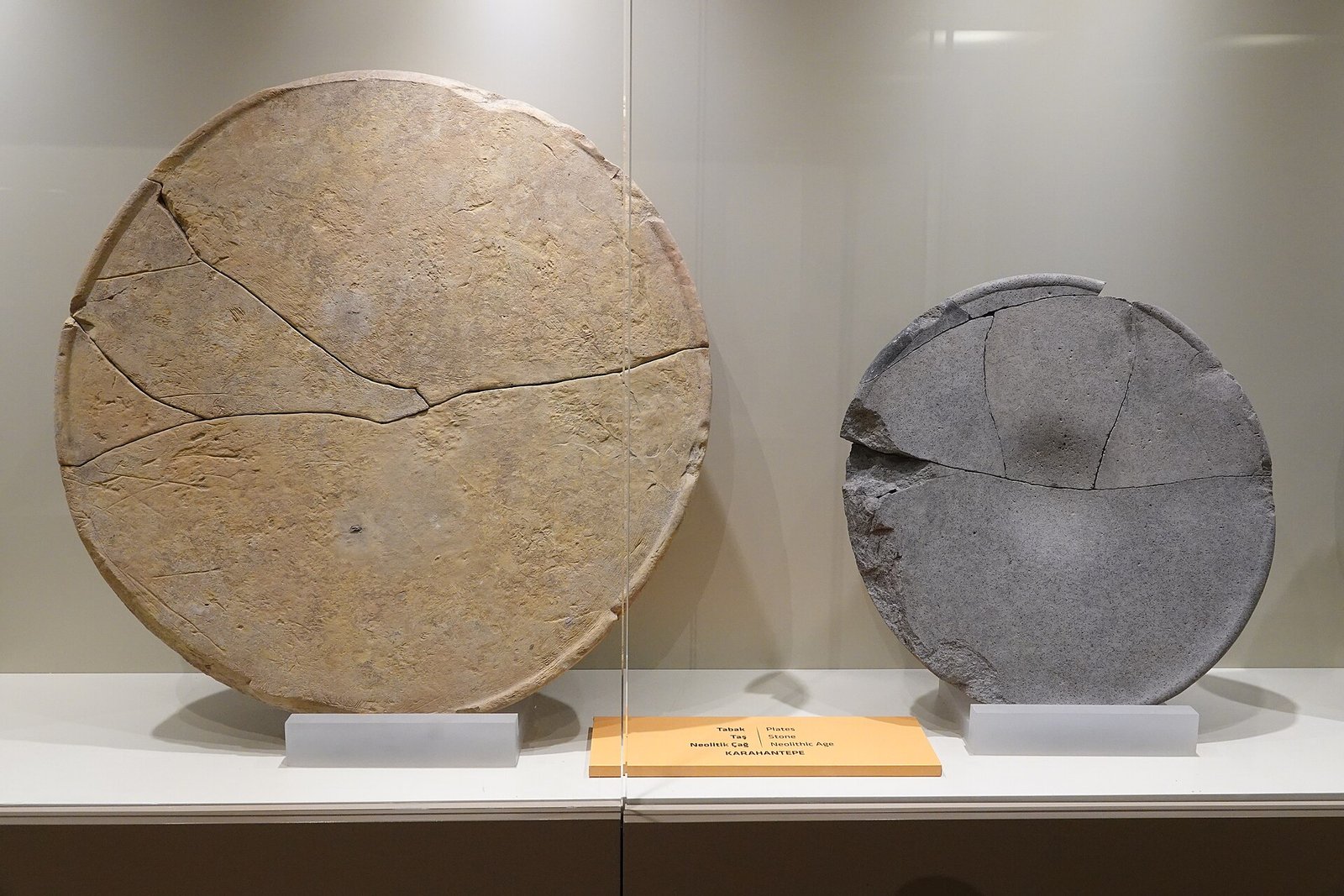
Survey and excavation have recovered a large assemblage of worked stone: arrowheads, scrapers, sickle blades, perforators and blades, alongside chisels and adzes, plus the heavier gear of daily life — grinding stones, pestles, stone vessels and beads.[1] Read together, the tools map directly onto the way people lived: arrowheads for hunting gazelle, sickle blades for harvesting wild grain, scrapers for working hides. This is the equipment of a foraging, not a farming, economy.
Here is the detail most accounts skip. Many of the sharpest tools are made not of local flint but of obsidian — volcanic glass that does not occur anywhere near Karahan Tepe.[1] Its natural sources lie in eastern Anatolia, around Bingöl and the Lake Van region, hundreds of kilometres away. For obsidian to reach this hilltop, it had to travel — passed along long-distance exchange networks that connected the Taş Tepeler to distant communities. The “isolated” sanctuary was, materially, anything but.
Trade means contact, and contact means ideas travel too. The obsidian that reached Karahan is a physical trace of the same connectivity that let a shared symbolic world — T-pillars, carved heads, the vulture and the leopard — spread across the region. The people who built Karahan weren't cut off from the world; they were a node in it.
The broad picture — a rich flint-and-obsidian toolkit, with obsidian sourced far to the east — is well established. Some of the precise object counts come from early survey reporting and vary between accounts, so we treat exact figures as reporting-grade pending the full excavation catalogue.
Arrowheads, scrapers, sickle blades, perforators, blades, chisels and adzes, plus grinding stones, pestles, stone vessels and beads — in both flint and obsidian.
Obsidian doesn't occur locally; its sources are in eastern Anatolia, hundreds of kilometres away. Its presence proves Karahan Tepe was connected to long-distance trade networks.
No — the toolkit and the food evidence point to hunting and gathering, not developed agriculture.
Karahan Tepe Research & Archive · Last updated September 2026.
The Karahan Tepe toolkit (flint and obsidian tools, grinding equipment, vessels and beads) is documented in survey and excavation reporting; obsidian is non-local and points to long-distance exchange with eastern Anatolian sources. Exact object counts vary between accounts and are flagged reporting-grade pending the full catalogue. Images are Karahan Tepe finds (Şanlıurfa Archaeology Museum / on site). This is a living archive summary, not an official academic publication.
Peer-reviewed excavation detail follows Karul 2021. Finds reported in 2024–2025 seasons are cited to project announcements and reputable coverage and are flagged as reporting-grade pending formal publication. See Sources & Method and Open Questions.
Explore further: What They Ate · The Village · Who Built It · More discoveries
See It For Yourself
Our small-group expedition takes you into Karahan Tepe's chambers with expert guides who explain what each one actually tells us.
Visit with our expert team →Free E-Book
Join the archive and receive our free e-book — plus updates whenever new discoveries emerge from the site.
No spam. Unsubscribe anytime.