 Karahan TepeResearch & Archive
Karahan TepeResearch & Archive
Karahan TepeResearch & Archive
Answers, Not Hype
Everything people ask about Karahan Tepe — where it is, how old it is, how to visit, who built it, and what the finds really mean. Answered clearly, and where the evidence runs out, we say so.
This page collects the questions we're asked most, in plain language. It's built to be trustworthy first: where something is established, we state it plainly; where it's interpretation or still unknown, we label it. If you want to go deeper on any answer, the links take you to a full page on that topic.
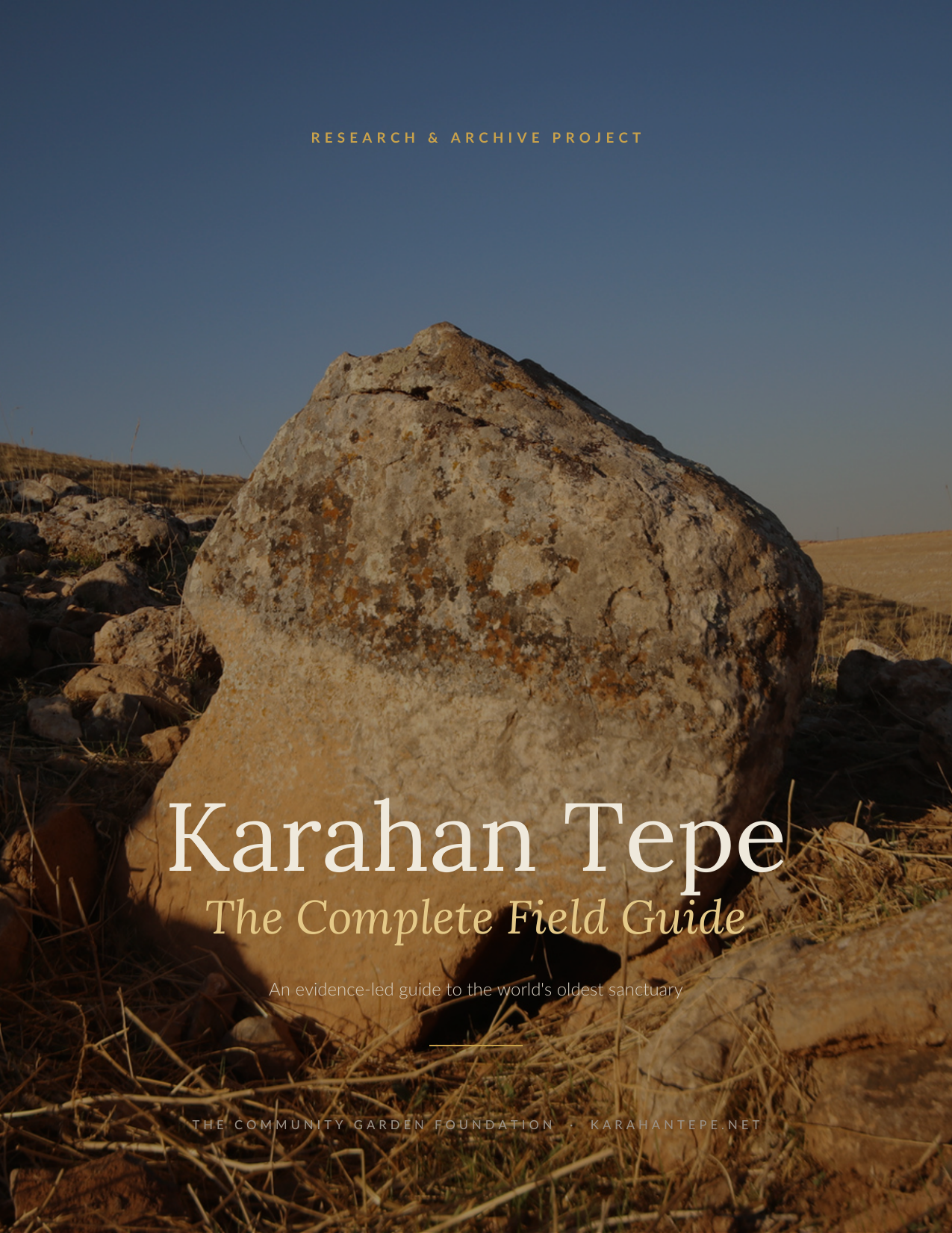
Karahan Tepe is a Pre-Pottery Neolithic site in southeastern Türkiye — a complex of rock-cut chambers, standing pillars, carved human heads and statues, built more than 11,000 years ago by hunter-gatherers, before pottery, metal, writing, or full farming. It is a sister site of Göbekli Tepe and part of the wider Taş Tepeler ("Stone Hills") network. Read the full overview →
In the Tek Tek Mountains of Şanlıurfa province, southeastern Türkiye, near the village of Keçili — about 46 km southeast of the city of Şanlıurfa, and roughly an hour from its sister site Göbekli Tepe. See exactly where, and how to get there →
More than 11,000 years old. Its main monumental phase dates to roughly 9500–8000 BCE, in the Pre-Pottery Neolithic — older than Stonehenge by around 6,000 years and older than the Great Pyramid by roughly 7,000. How we know its age →
Roughly kah-rah-HAN teh-peh. In Turkish, "tepe" means "hill" or "mound," so the name means, loosely, "the black hill." You'll also see it written as one word, "Karahantepe."
"Tepe" is Turkish for hill or mound; "Karahan" is a local place-name. Like most Taş Tepeler sites, its modern name is simply the name of the hill it sits on — we have no idea what its builders called it.
They are contemporary sister sites in the same culture, but they feel very different. Göbekli Tepe is built up — rings of free-standing T-pillars quarried and raised on a ridge, carved mostly with animals. Karahan Tepe is cut down — chambers carved into the living bedrock, with a stronger focus on the human form: carved heads, statues, and a room of pillars around a watching face. The full comparison →
Honestly: not proven. The two are broadly contemporary. Göbekli Tepe's earliest enclosures currently hold the record for the oldest securely-dated monumental architecture anywhere, and Karahan sits right alongside it. Claims that Karahan is "older" run ahead of the published evidence. Why the honest answer is "we don't know yet" →
About an hour apart by road — close enough to see both in a single day from a base in Şanlıurfa, ideally with the Şanlıurfa Archaeology Museum in between. Plan the day →
Yes. Karahan Tepe is open to visitors and is about an hour from Şanlıurfa, reached by car, taxi, or guided tour — there is no public transport to the site itself. It remains an open-air, active excavation site rather than a developed attraction: there is no built walkway or protective shelter yet (a protective roof over the excavated area is planned for after the 2026 season). The full visitor guide →
Spring (March–May) and autumn (September–November), when temperatures are comfortable. Summers regularly exceed 40°C with almost no shade on site, so if you go in summer, arrive at opening time and carry plenty of water.
Allow one to two hours for the site itself. Combined with Göbekli Tepe and the Şanlıurfa Archaeology Museum, it makes a full and rewarding day.
Entry is inexpensive and the Turkish MüzeKart (Museum Pass) is generally accepted, but hours and prices change seasonally and without much notice. Always confirm current details before you travel. Current practical details →
If you have any interest in where settled human life began, yes — you are standing at the edge of what is currently being discovered, not a monument long since fully explained. Only a small fraction of the site has been excavated, so what you see is genuinely new to human knowledge.
Karahan Tepe's most famous chamber: a semi-subterranean room cut into bedrock, containing eleven upright pillars and a human head that emerges from the wall to watch over them. Ten of the pillars are shaped from the bedrock itself. Inside the Pillar Room →
A roughly 2.3-metre statue of a seated man, carved around 9400 BCE, with ribs and spine incised across the torso and hands brought to the front of the body. He was found set into a niche and fixed to the ground — one of the earliest realistic depictions of a specific human being. Meet the Ribbed Man →
The human head was clearly central to these people. Karahan produced remarkably lifelike carved heads and faces, and at neighbouring Göbekli Tepe archaeologists have documented heads deliberately detached and placed. What it all meant is debated — ancestor veneration is one leading reading, but it remains interpretation. The carved heads →
Geophysical survey suggests well over 250 pillars across the site, most of them still buried. Only a small fraction of Karahan Tepe has been excavated, so the count will keep rising.
The leopard dominates — carved as sculpture and curated as bone. Around it move the snake (a recurring motif, even cut into the floor as a channel), a fox, a running wild donkey, and a vulture. The carved bestiary →
Hunter-gatherers — not a "lost civilization." People who had not yet fully committed to farming coordinated enormous labour to carve chambers out of solid rock. That's the real astonishment: monumental building came before the farming and cities we assumed were required for it. Who built it →
No. The evidence points firmly to local Neolithic communities using flint and stone tools, and it is genuinely more remarkable that way. We take the lost-civilization, Atlantis, and ancient-aliens claims seriously enough to weigh them against the evidence — and explain where they fall down. The theories, weighed honestly →
Most likely ritual and gathering — the architecture is built to be descended into, moved through, and finally, deliberately, sealed. Specific readings (initiation, ancestor rites, fertility) are interpretation, not settled fact, and we mark them as such. One leading interpretation →
Prof. Necmi Karul of Istanbul University leads the excavations, as part of the Taş Tepeler project overseen by Türkiye's Ministry of Culture and Tourism. Systematic digging began in 2019.
Not yet. It is on Türkiye's Tentative World Heritage List, alongside the wider Taş Tepeler nomination; a full inscription may follow. Its sister site Göbekli Tepe was inscribed in 2018.
Many of the movable sculptures — carved heads, statues, the leopard and vulture sculptures — are held in the Şanlıurfa Archaeology Museum, which makes the natural companion visit to the site. Larger features like the bedrock pillars and the carved head in the Pillar Room remain on site.
Free E-Book
Join the archive and receive our free e-book — plus updates whenever new discoveries emerge from the Taş Tepeler region.
No spam. Unsubscribe anytime.