 Karahan TepeResearch & Archive
Karahan TepeResearch & Archive
Karahan TepeResearch & Archive
Eleven Thousand Years
It was built at the dawn of settled life, used for centuries, and then deliberately buried by the very people who made it. It lay silent for eleven thousand years — until a survey in 1997, and the excavations that are still rewriting the story today.
The history of Karahan Tepe divides into two stories separated by an enormous silence. First there is the deep history — a few centuries around 9500–8000 BCE when the site was carved, used, and finally closed. Then, after more than ten thousand years underground, the modern history — the survey, the excavation, and the ongoing discoveries that are still going on right now.
For the methods behind these dates — radiocarbon, stratigraphy, and how Göbekli Tepe anchors the chronology — see How We Know Karahan Tepe’s Age.
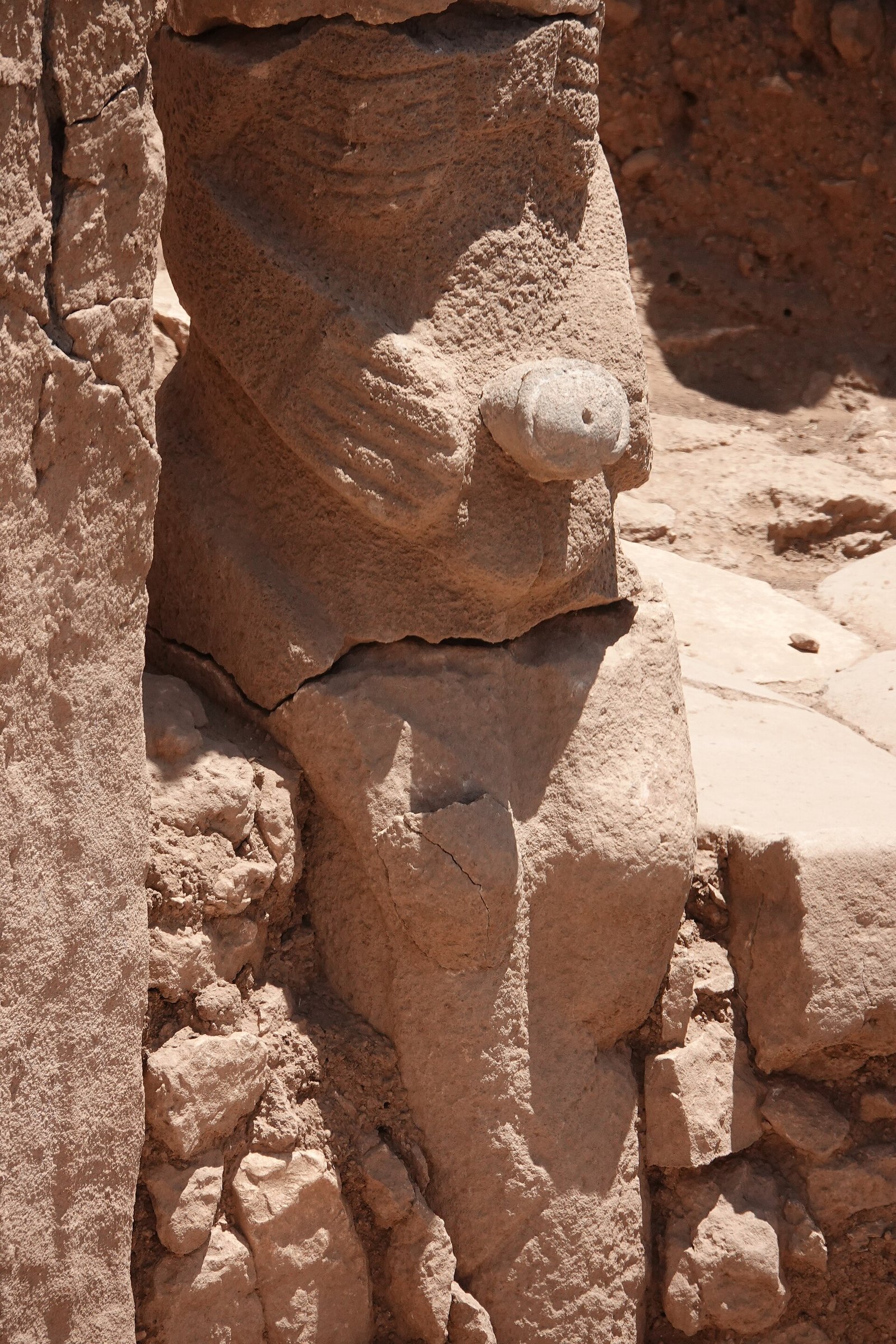
Karahan Tepe was made in the Pre-Pottery Neolithic, the era just after the last Ice Age when people were beginning to settle but had not yet fully committed to farming. They had no pottery, no metal, and no writing. With flint and stone tools, they cut chambers straight down into the limestone bedrock of the hill, shaped pillars out of the living rock, and carved human heads and statues of startling realism.
This is the fact that overturned decades of assumption: monumental architecture like this was supposed to require farming, surplus, and cities to organise the labour. Karahan Tepe — like its sister site Göbekli Tepe — shows the opposite. The building came first. Who built it, and how →
Karahan Tepe did not simply fall into ruin. At the end of its life, key structures — including the famous Pillar Room — were intentionally filled in and sealed, in staged layers, with large stones placed deliberately over the rear pillars. The same closing gesture is seen across the Taş Tepeler. Why they buried their own sacred places is one of the great open questions of the Neolithic. Why they buried their temple →
For more than ten thousand years the hill kept its secret. It was known locally simply as Karahan — "the black hill." Its surface was scattered with worked flint and the tops of buried stones, but like Göbekli Tepe before it, nobody suspected how old, or how important, what lay beneath really was.
The site was formally identified during a regional survey in 1997 by researcher Bahattin Çelik, who recognised its potential significance. But it was not until 2019 — when it was folded into Türkiye's ambitious Taş Tepeler project under Prof. Necmi Karul of Istanbul University — that systematic excavation began. What came out of the ground in the seasons that followed turned Karahan Tepe into international news. And crucially, only a small fraction of the site has been dug: the history of Karahan Tepe is still being written, one season at a time. Follow the latest discoveries →
Its main monumental phase dates to roughly 9500–8000 BCE, in the Pre-Pottery Neolithic — more than 11,000 years ago.
The site was identified in a 1997 regional survey by Bahattin Çelik. Systematic excavation began later, in 2019, under Prof. Necmi Karul of Istanbul University.
Rather than being abandoned to decay, key structures were deliberately buried and sealed by the people who used them — a deliberate closure seen across the Taş Tepeler. The reasons remain debated.
Peer-reviewed excavation detail follows Karul 2021. Finds reported in 2024–2025 seasons are cited to project announcements and reputable coverage and are flagged as reporting-grade pending formal publication. See Sources & Method and Open Questions.
Free E-Book
Join the archive and receive our free e-book — plus updates whenever new discoveries emerge from the Taş Tepeler region.
No spam. Unsubscribe anytime.