 Karahan TepeResearch & Archive
Karahan TepeResearch & Archive
Karahan TepeResearch & Archive
Dating & Methods
“More than 11,000 years old” is the headline. Here is how archaeologists actually establish it — radiocarbon, stratigraphy, typology, and the securely-dated neighbour next door.
“More than 11,000 years old” is the headline — but how do archaeologists actually know that? The honest answer is more interesting, and more careful, than most sites admit: Karahan Tepe’s age rests less on a single carbon date than on where it sits in the Pre-Pottery Neolithic world, and on its securely-dated neighbour, Göbekli Tepe.
Karahan Tepe belongs to the Pre-Pottery Neolithic (PPN) — broadly the tenth to ninth millennia BCE, or roughly 9500–8000 BCE for its main horizon.[1] That places its monumental building thousands of years before pottery, metal, writing, or farming villages as we usually picture them. The 2025 human-faced pillar, for instance, is reported to date to around the start of the ninth millennium BCE.[2]
Radiocarbon dating measures the age of organic material — charcoal, bone, seeds — not the limestone a chamber is carved from. To date a rock-cut building, you have to date organic samples found in secure association with it: material sealed in a floor, a hearth, or the deliberate fill that closed a room. At Karahan Tepe, where several structures were intentionally back-filled, that association is both a help (sealed contexts) and a challenge (you are dating the closure, not necessarily the first use). This is exactly why we treat some figures as reported rather than settled.
Karahan Tepe’s strongest dating argument is comparative. Its neighbour Göbekli Tepe, an hour away, has been excavated for decades and carries a substantial radiocarbon sequence established by the German Archaeological Institute.[3] Karahan shares Göbekli’s defining material culture — T-shaped pillars, rock-cut enclosures, the same tool traditions and animal imagery — so the two are understood as broadly contemporary parts of one Pre-Pottery Neolithic phenomenon. When Karahan’s own absolute dates are fully published, they are expected to refine, not overturn, that placement.
Three independent lines converge on the age. Stratigraphy: the sequence of floors, fills and rebuilds records relative order. Typology: the forms of the pillars, tools and vessels match known PPN assemblages. Material culture: the complete absence of pottery and domesticated staples is itself a chronological marker — it is an aceramic, pre-farming world. Together these place Karahan Tepe firmly in the PPN even where a specific lab date has not yet been printed for a specific room.
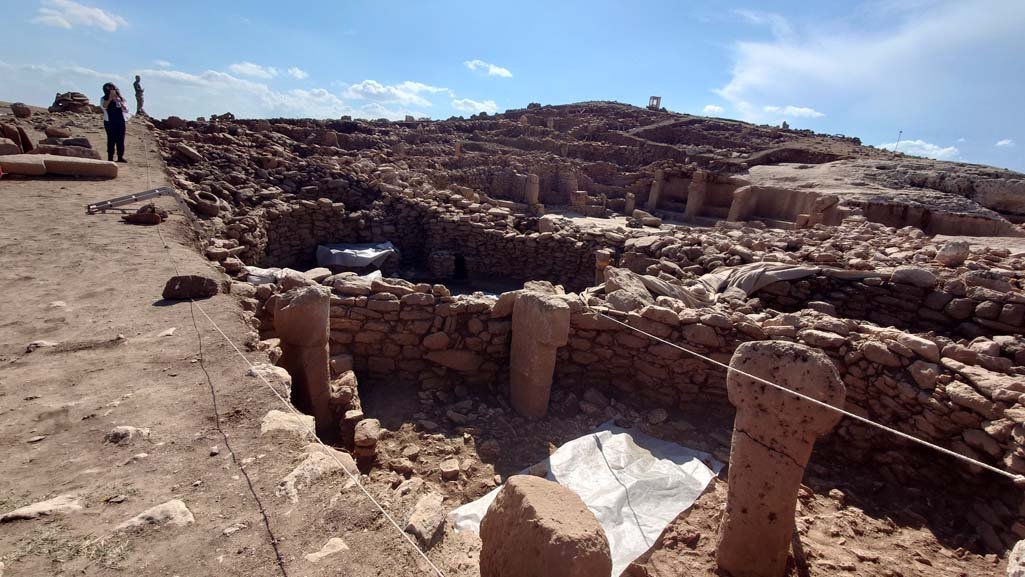
We keep this honest: as of 2026, the number of published absolute radiocarbon dates from Karahan Tepe itself is limited, and much of the fine chronology — which structure came first, how long the site was in use, when each was closed — awaits formal publication of the excavation’s dating programme. “More than 11,000 years old” is well supported; a room-by-room calendar is not yet available.
Its main horizon falls in the Pre-Pottery Neolithic, broadly 9500–8000 BCE — more than 11,000 years ago. A precise, room-by-room chronology awaits full publication.
Its age is anchored by material-culture parallels to the radiocarbon-dated Göbekli Tepe and by PPN typology; the number of published absolute dates from Karahan itself is still limited.
They are broadly contemporary. Karahan is not proven to be older — see the honest answer.
Karahan Tepe Research & Archive · Last updated July 2026. This page is an independent synthesis of the published record; it separates documented fact, interpretation, and open question, and is not an official academic publication.
Peer-reviewed excavation detail follows Karul 2021. Finds reported in 2024–2025 seasons are cited to project announcements and reputable coverage and are flagged as reporting-grade pending formal publication. See Sources & Method and Open Questions.
Continue in The Atlas, or see Open Questions and Sources & Method.
See It For Yourself
Our small-group expedition takes you into Karahan Tepe's chambers with expert guides who explain what each one actually tells us.
Visit with our expert team →Free E-Book
Join the archive and receive our free e-book — plus updates whenever new discoveries emerge from the site.
No spam. Unsubscribe anytime.