 Karahan TepeResearch & Archive
Karahan TepeResearch & Archive
Karahan TepeResearch & Archive
Discoveries · The Power of the Head
A stone slab with two carved human heads at Sefer Tepe, set beside Karahan Tepe's rock-cut faces and the curated skulls of the Neolithic world — a documented concern with the head that ran deep, and wide.
A stone slab carved with two human heads, recently reported from Sefer Tepe, is a striking object in its own right. It also lands inside a much larger and well-documented pattern: across the Neolithic Near East, communities returned again and again to the human head — carving it, showing it detached from the body, and, in the case of real skulls, removing and curating it after death. This article sets the Sefer Tepe slab beside that wider record, and tries to keep a clear line between what is documented and what is interpretation.
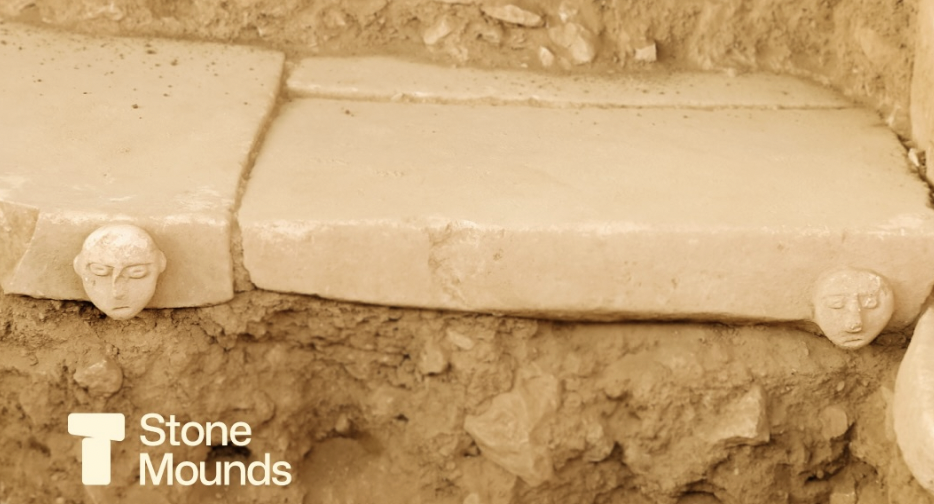
The Sefer Tepe piece is a carved architectural slab, most likely built into a wall or structural feature, with a small human head worked into each end in clear symmetry. It has been reported by the excavation team rather than published in a formal excavation report, so the details of its context and date are still preliminary, and we treat it as reporting-grade. What can be said conservatively is that it isolates the head as the primary carved element — the same emphasis found across the Taş Tepeler, where the human presence is repeatedly reduced to the face and upper body rather than the whole figure.
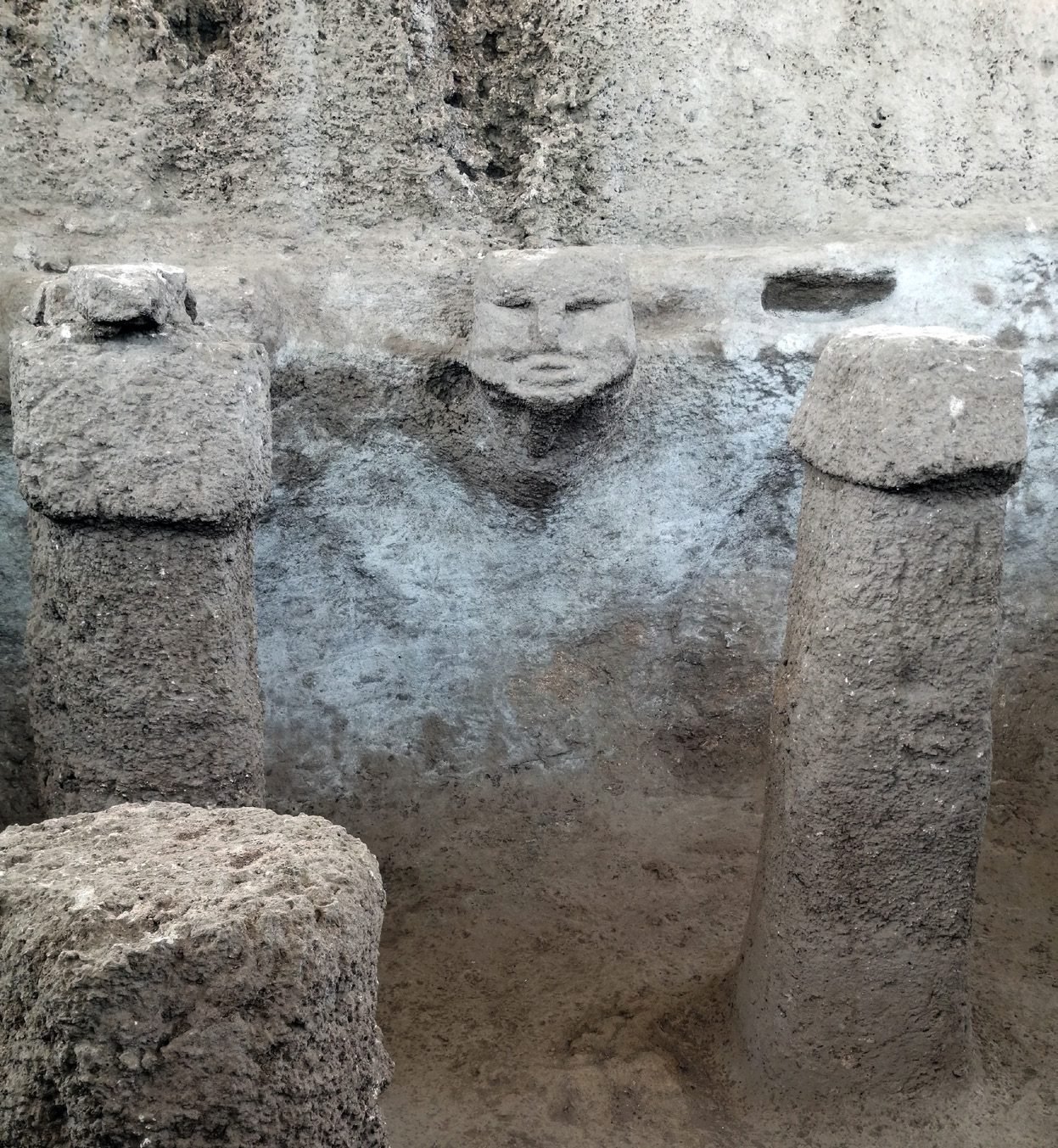
At Karahan Tepe the emphasis on the head is direct and documented. Excavation has revealed human faces carved from the bedrock inside the rock-cut chambers — not loose objects, but faces integrated into the architecture itself, looking outward from the wall to anyone standing in the room (Karul, 2021). The site has also produced anthropomorphic figures whose torsos are rendered almost skeletal.
The concern with the head is not only a matter of carved images. A bioarchaeological study of human remains from the site, led by Yılmaz Selim Erdal, reports more than a dozen skull fragments; several show cut-marks made with flint and obsidian tools, along with traces of exposure to fire. The excavation director, Necmi Karul, has linked this treatment to rituals concerned with the passage between life and death. These results have been announced through the Taş Tepeler project and press coverage and are best treated as reporting-grade until the full study is published — but they suggest the people who carved heads in stone were also, in some way, handling the real ones. (More in how they treated their dead.)
Karahan Tepe is one node in a much broader phenomenon. Across the Pre-Pottery Neolithic of Upper Mesopotamia and the Levant, skulls were frequently treated differently from the rest of the body — removed from burials, gathered, and re-placed in the built world:
Why treat the skull this way? Archaeologists such as Ian Kuijt have argued that as people settled into permanent villages, the dead — and especially the head — became a means of maintaining continuity with ancestors, and with them a claim on place and lineage (Kuijt, 2008). On that reading, keeping and displaying the skull folded the dead back into the world of the living rather than sending them away. Seen against this background, the carved heads at Karahan Tepe and the slab at Sefer Tepe look less like decoration and more like architectural echoes of the same concern. We present that connection as interpretation, not established fact.
The doubled head is a second, looser strand, and it needs handling with care. It is tempting to line up every paired head into a single tradition, but the clearest examples are separated by hundreds of kilometres and, in places, by many centuries. They are better understood as a motif that recurred independently across the Neolithic world than as one lineage handed from site to site.
At Çatalhöyük, in central Anatolia, twin and two-figure images appear in both figurines and reliefs. But Çatalhöyük lies far to the west of the Taş Tepeler and belongs to the later Pottery Neolithic (roughly 7100–5700 BCE) — so it is a parallel, not an ancestor of the Stone Hills sites.
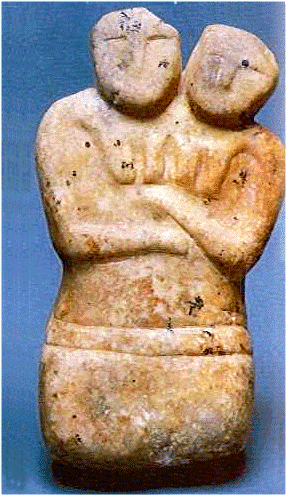
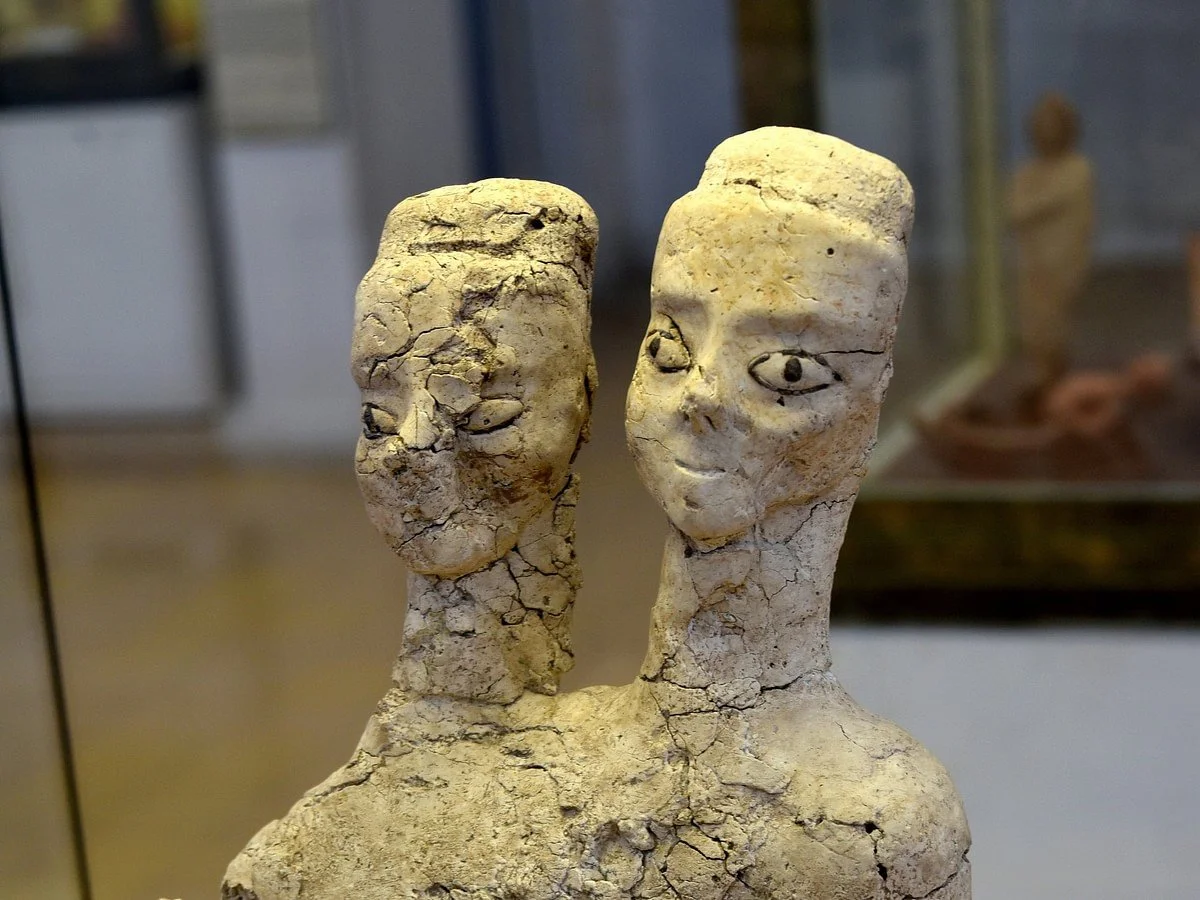
Further south, at ʿAin Ghazal in Jordan, Neolithic villagers modelled two-headed busts in plaster. These belong to the Late Pre-Pottery Neolithic B, around 6500 BCE — again, a different region and a later date than Karahan Tepe. Two-headed and twinned images are known from other Neolithic sites as well, including Tell Brak. What is striking is not a line of descent but that the doubled human form kept being chosen, in far-flung places and different eras.
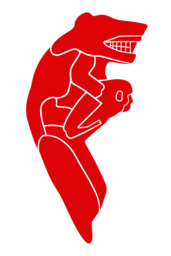
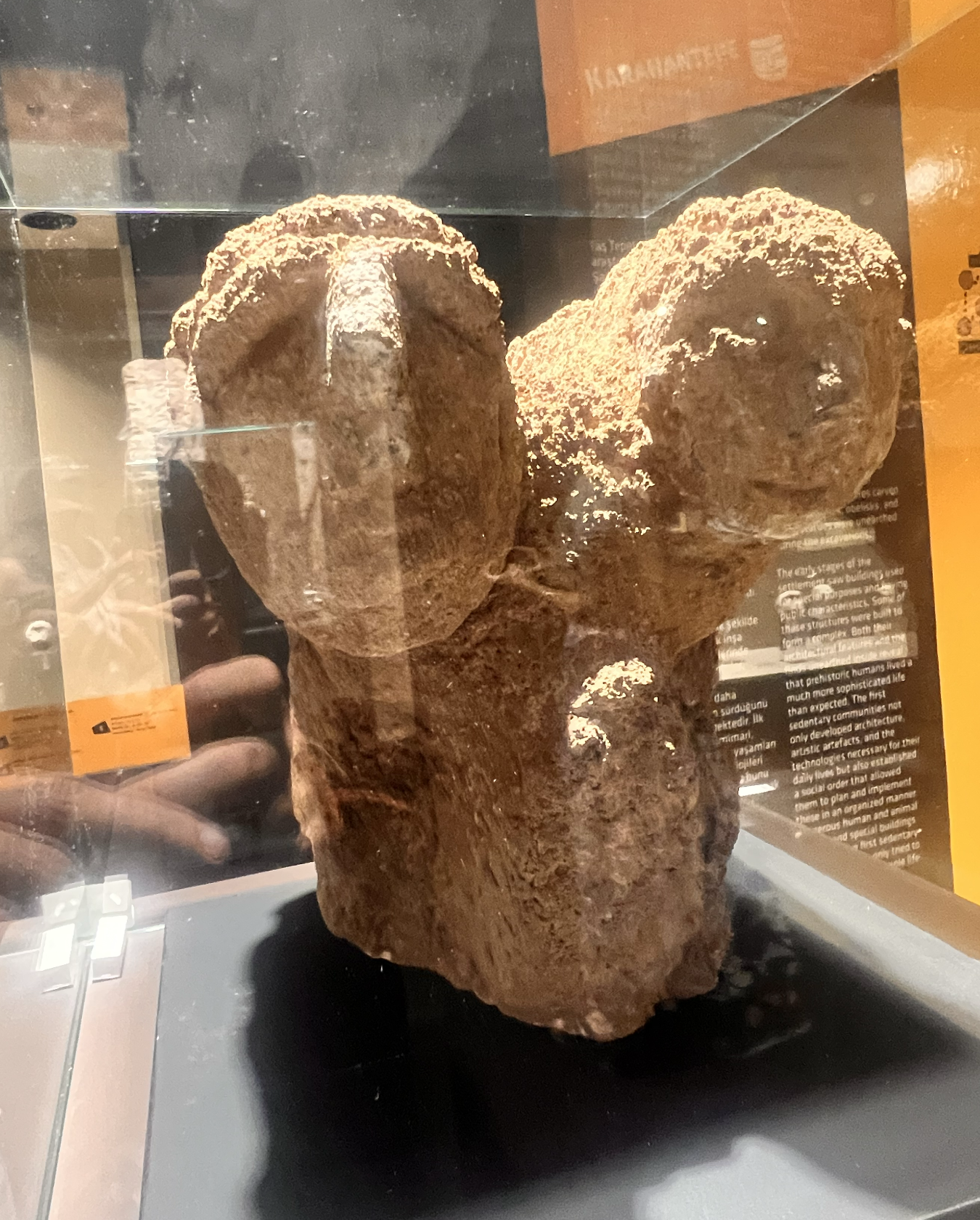
Karahan Tepe itself may belong in this company. A stone sculpture with two heads worked on a single body is displayed in the Karahan Tepe section of the Şanlıurfa Archaeology Museum. At the time of writing it is an object on public display rather than one described in a formal excavation report, so we show it as a documented museum piece while leaving its date, context and meaning open.
The documented core is solid: a Neolithic Near East unusually focused on the head and the skull, expressed in carved faces, detached heads, curated and modified crania, and — here and there — doubled human forms. The connections between specific sites are the interpretive part. The comparison drawn together on this page — reading Sefer Tepe's slab alongside Karahan's faces, Çayönü's skulls, Çatalhöyük's twins and ʿAin Ghazal's busts — is our own synthesis, assembled by Dakota Wint for this archive. We offer it as a lens for seeing a real and repeated preoccupation across the Neolithic world, not as a claim that these communities shared one belief or passed a single tradition between them.
We can say that the head mattered — repeatedly, and across a wide area and a long span of time. We cannot yet say what, precisely, it meant, and the honest position is that no one can. Each new find, including the Sefer Tepe slab, sharpens the pattern without closing the question.
A carved stone slab with two human heads, one worked into each end — most likely part of a wall or architectural feature. It has been reported by the excavation team and is best treated as a preliminary (reporting-grade) find, belonging to the head-focused symbolic tradition seen across the Taş Tepeler.
Yes to the carved heads: human faces cut from the bedrock and set into the architecture are documented (Karul, 2021). A twin-headed stone sculpture is also displayed in the Karahan Tepe hall of the Şanlıurfa Archaeology Museum, but it has not yet been formally published, so its context and meaning remain open.
A shorthand for the widespread practice of removing, curating, modifying and sometimes plastering human skulls and re-placing them in buildings — documented across the Pre-Pottery Neolithic Near East (for example at Çayönü, Göbekli Tepe, Jericho and ʿAin Ghazal). The carved heads of the Taş Tepeler are often read as related to this concern with ancestry and the dead, though that link is interpretive.
No — and it would be misleading to say so. The sites span different regions (Upper Mesopotamia, central Anatolia, the southern Levant) and, in some cases, more than a thousand years. They are better understood as independent expressions of a shared, long-lived preoccupation with the head, not a single lineage passed from one site to the next.
Karahan Tepe Research & Archive · Last updated September 2026.
The Sefer Tepe double-headed slab is reported by the Sefertepe excavation team (via Stone Mounds) and is treated as reporting-grade pending publication. Karahan Tepe's rock-cut faces follow Karul (2021); the modified human skulls follow bioarchaeological reporting associated with Y. S. Erdal and statements by N. Karul, announced via the Taş Tepeler project and press coverage (reporting-grade). The twin-headed sculpture is shown as an object on display in the Şanlıurfa Archaeology Museum and is not, to our knowledge, yet formally published. The Çayönü "Skull Building," Göbekli Tepe's carved crania (Gresky et al., 2017), and the ʿAin Ghazal two-headed plaster busts (Late PPNB, c. 6500 BCE) are published parallels from different regions and periods. The twin figure previously captioned "Çayönü" is corrected here to Çatalhöyük (central Anatolia, Pottery Neolithic). The cross-regional comparison is an interpretive synthesis by Dakota Wint of this archive, offered as such and kept separate from the finds themselves. This is a living archive summary, not an official academic publication.
Peer-reviewed excavation detail follows Karul 2021 and the published parallels above. Finds reported in the 2024–2026 seasons (including the Sefer Tepe slab and the Karahan skull study) are cited to project announcements and press coverage and are flagged as reporting-grade pending formal publication. See Sources & Method and Open Questions.
Explore further: The Carved Heads of Karahan · Human Figures · Sefertepe.com · More discoveries
Free E-Book
Join the archive and receive our free e-book — plus updates whenever new discoveries emerge from the site and the wider Taş Tepeler region.
No spam. Unsubscribe anytime.